Sustainability is changing how organisations operate, make decisions and plan for the future. As businesses work towards environmental targets, climate commitments and responsible business practices, the demand for skilled sustainability professionals is becoming increasingly important.
However, recruiting sustainability talent requires more than publishing job vacancies and selecting candidates with relevant qualifications. Organisations need to rethink how they identify skills, develop talent pipelines and organise teams to meet changing sustainability requirements.
The traditional recruitment model, which often focuses on filling individual positions, may not be sufficient for the evolving green economy. A more flexible, technology-enabled and skills-based talent operating model can help businesses prepare for future workforce needs.
Why Sustainability Recruitment Needs a New Approach
Sustainability responsibilities are no longer limited to environmental departments. They increasingly influence finance, technology, procurement, operations, engineering and supply chain management.
For example, companies may need carbon accounting specialists to measure emissions, sustainability analysts to evaluate environmental performance, renewable energy professionals to support clean energy projects and ESG specialists to manage reporting requirements.
These responsibilities require different combinations of technical knowledge, business understanding and environmental expertise.
Recruitment teams must therefore look beyond traditional sustainability job titles and identify candidates with transferable skills that can contribute to environmental objectives.
1. Moving Towards Skills-Based Sustainability Hiring
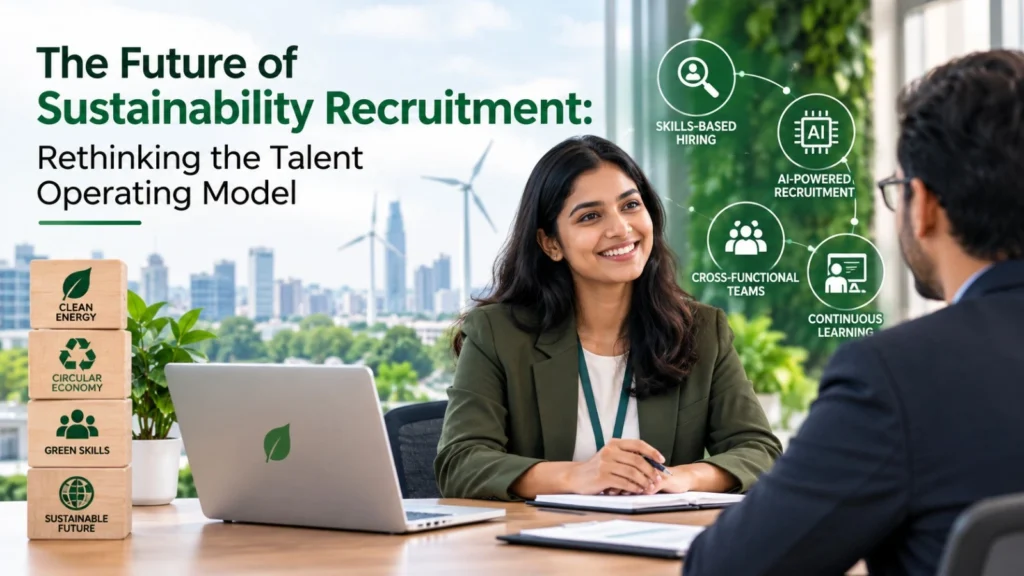
One important shift in recruitment is the growing importance of skills over job titles alone.
A candidate with experience in data analytics, engineering, financial analysis or supply chain management may already possess capabilities relevant to sustainability roles.
For example, a data analyst with experience in energy consumption reporting could develop into an energy analytics professional through additional sustainability training.
Employers should evaluate practical experience, technical capabilities, relevant projects and learning potential alongside formal qualifications.
This approach can expand the available talent pool and create opportunities for professionals transitioning into sustainability careers.
2. Using AI to Improve Sustainability Recruitment
Artificial intelligence is creating new possibilities for recruitment teams.
AI-supported tools can help organisations organise applications, identify relevant skills, analyse candidate profiles and improve the efficiency of recruitment processes.
In sustainability recruitment, these technologies may help employers identify candidates with experience in environmental management, climate data, renewable energy, ESG reporting and carbon measurement.
However, technology alone cannot create an effective recruitment strategy.
Human judgement remains essential when assessing professional experience, problem-solving abilities, communication and practical knowledge. Organisations must also consider candidate privacy, fairness and potential algorithmic bias when introducing AI-powered recruitment systems.
3. Building Flexible and Cross-Functional Sustainability Teams
Sustainability challenges often require collaboration between different business functions.
Instead of depending entirely on a single sustainability department, organisations can develop cross-functional teams involving professionals from finance, technology, operations, procurement and environmental management.
This structure allows sustainability expertise to become part of everyday business decisions.
Flexible project-based teams can also help organisations bring together the right specialists for specific objectives, such as emissions reduction, renewable energy implementation or sustainable supply chain development.
4. Investing in Continuous Green Skills Development
Recruitment cannot be the only solution to sustainability talent shortages.
Organisations should also invest in employee development, professional training, internships and partnerships with educational institutions.
Existing employees can acquire new capabilities through structured learning programmes, while students and early-career professionals can gain practical experience through sustainability projects.
Developing internal talent can help businesses address emerging skill requirements and build a more adaptable workforce.
What Organisations Should Prioritise Next
Businesses looking to strengthen their sustainability recruitment strategies should focus on three priorities:
- Identify future skills requirements: Understand which sustainability capabilities will be important for upcoming business and environmental objectives.
- Modernise recruitment processes: Combine skills-based hiring, appropriate AI tools and human-led candidate evaluation.
- Develop long-term talent pipelines: Invest in training, internships, internal mobility and partnerships that support future workforce development.
Conclusion
The future of sustainability recruitment will depend on how effectively organisations connect talent strategy with business transformation and environmental priorities.
Traditional hiring practices must evolve towards more flexible workforce planning, skills-based recruitment, responsible use of AI and continuous professional development.
As sustainability becomes increasingly integrated into business operations, organisations will need professionals who can combine environmental knowledge with technical and commercial capabilities.
Rethinking the talent operating model is therefore not simply an HR transformation. It is an important step towards building a workforce capable of supporting the long-term sustainability transition.
At GreenSkil, understanding the connection between green skills, emerging careers and workforce transformation is essential to exploring the future of sustainability talent.