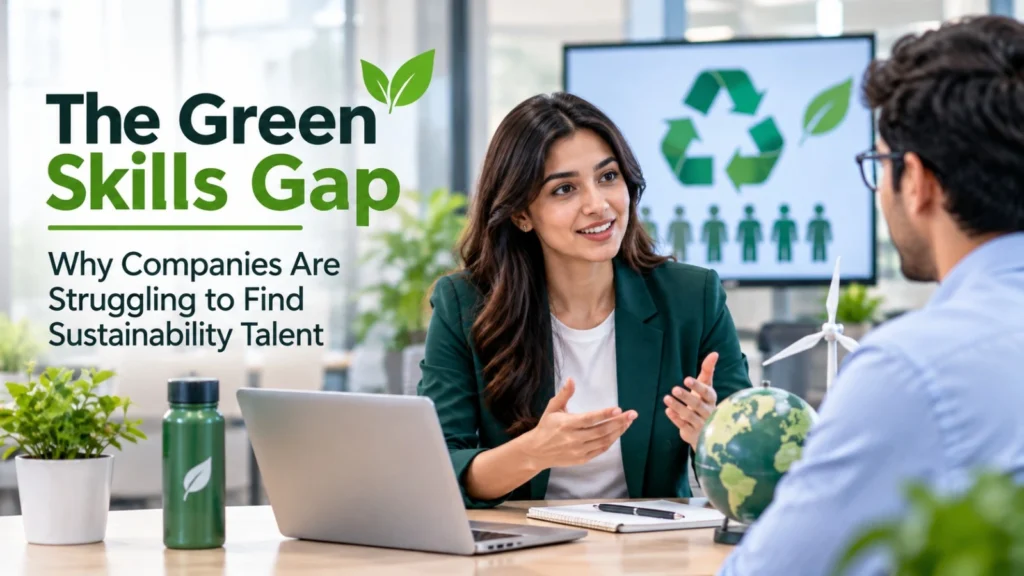
Sustainability has become an important part of how businesses plan for the future. Companies are working to reduce their environmental impact, improve energy efficiency, understand their carbon emissions and make their operations more responsible. But while these goals are becoming more common, finding the right people to make them happen is proving difficult.
Many organisations know they need sustainability professionals, but they are not always sure where to find them or what skills to look for. Some need people who understand climate-related issues, while others are searching for professionals with experience in environmental management, ESG reporting, renewable energy or sustainable supply chains.
This growing mismatch between what companies need and what candidates can offer is known as the green skills gap. And as the world of work continues to change, it is becoming a challenge that employers cannot afford to ignore.
The Changing World of Work Is Creating New Opportunities
The job market is changing faster than many businesses expected. A recent LinkedIn discussion highlighted projections that 92 million jobs could be displaced by 2030, while 170 million new jobs could be created. These figures point towards a major shift in the types of work people will do and the skills employers will need.
Sustainability is part of this transition.
As companies invest in cleaner technologies and rethink their operations, they need people who can turn environmental goals into practical business decisions. This includes professionals who can manage energy efficiency projects, measure carbon emissions, develop sustainability strategies and improve resource management.
However, new job opportunities do not automatically mean there will be enough qualified candidates to fill them. Many professionals are still developing the knowledge and experience needed for these emerging roles.
That is where the green skills gap becomes a real concern for employers.
Why Finding the Right Sustainability Professionals Is Difficult
One reason sustainability recruitment is challenging is that these jobs often require a combination of different skills.
For example, a company looking for a sustainability manager may need someone who understands environmental performance, can analyse business data, communicate with different teams and help management make informed decisions.
Finding all these abilities in one candidate is not always easy.
Another difficulty is that sustainability is no longer limited to a particular department. It now influences areas such as finance, operations, procurement, technology and supply chain management.
A procurement professional may need to understand responsible sourcing. A data analyst may be asked to track carbon emissions. An operations manager may need to identify ways to reduce energy consumption.
This means companies are not just looking for sustainability specialists. They also need employees in traditional roles who understand how sustainability connects with their everyday responsibilities.
How AI Is Changing Sustainability Recruitment
Technology is creating another important shift in the recruitment process.
In its discussion of the future HR operating model, Gartner highlights how artificial intelligence is changing traditional HR activities and encouraging organisations to rethink how work gets done.
For recruitment teams, AI can make certain tasks easier. It can help organise applications, identify relevant skills, support candidate searches and reduce the time spent on repetitive administrative work.
This could be particularly useful when companies are hiring for specialised sustainability positions, where finding suitable candidates may take longer.
However, recruitment is not just about matching keywords on a CV.
A candidate might have the right qualifications but lack the practical experience needed to manage a sustainability project. Another candidate may come from a different professional background but have strong analytical, communication and problem-solving skills.
Understanding these differences still requires human judgement.
The best approach is to use AI to support recruitment decisions while allowing recruiters to assess a candidate’s experience, potential and ability to contribute to the organisation.
Why Human Skills Are Just as Important as Technical Knowledge
Technical knowledge matters in sustainability, but employers should not overlook the human skills that help people do their jobs effectively.
Analytical thinking, communication, adaptability, leadership and problem-solving are particularly valuable because sustainability challenges rarely have simple solutions.
Consider a company trying to reduce its carbon emissions. The work may involve reviewing energy consumption, changing procurement practices, coordinating with suppliers and encouraging employees to adopt new processes.
A sustainability professional needs to understand the technical side of the problem, but they also need to work with people, explain decisions and bring different teams together.
This is why companies should look beyond qualifications and focus on what candidates can actually contribute.
Professionals with experience in engineering, business, data analytics, operations and project management may also have transferable skills that can be developed for sustainability-related work.
What Companies Can Do to Close the Green Skills Gap
Finding sustainability talent requires more than publishing job vacancies and waiting for applications. Companies need to think about how they develop and attract the right people.
Start by understanding the skills you need. Before recruiting, businesses should identify the sustainability goals they want to achieve and the capabilities required to reach them.
Look beyond traditional job titles. Suitable candidates may come from industries and professional backgrounds that are not traditionally associated with sustainability. Transferable skills can be just as valuable as direct experience.
Invest in employee training. Companies do not always need to hire someone new. Training existing employees in areas such as carbon management, environmental reporting and sustainable operations can help address internal skills shortages.
Make better use of recruitment technology. AI-powered tools can support candidate searches and skills assessments, but employers should maintain a human approach when evaluating applicants.
Plan for future workforce needs. Sustainability should be part of long-term workforce planning rather than something businesses address only when a vacancy arises.
The Future of Sustainability Recruiting
The green skills gap is unlikely to disappear simply because more sustainability jobs are being created. Businesses must also invest in the people who will carry out this work.
The combination of technological change, evolving business expectations and environmental challenges is making workforce planning more important than ever.
Companies that recognise this early can build teams with the right mix of technical knowledge, practical experience and human skills. They can also create opportunities for existing employees to develop and move into emerging sustainability roles.
Ultimately, sustainability is not just about setting environmental targets or introducing new technologies. It is about having people who understand what needs to change and know how to make that change happen.
The companies that prepare their workforce today will be in a much stronger position to meet the sustainability challenges of tomorrow.