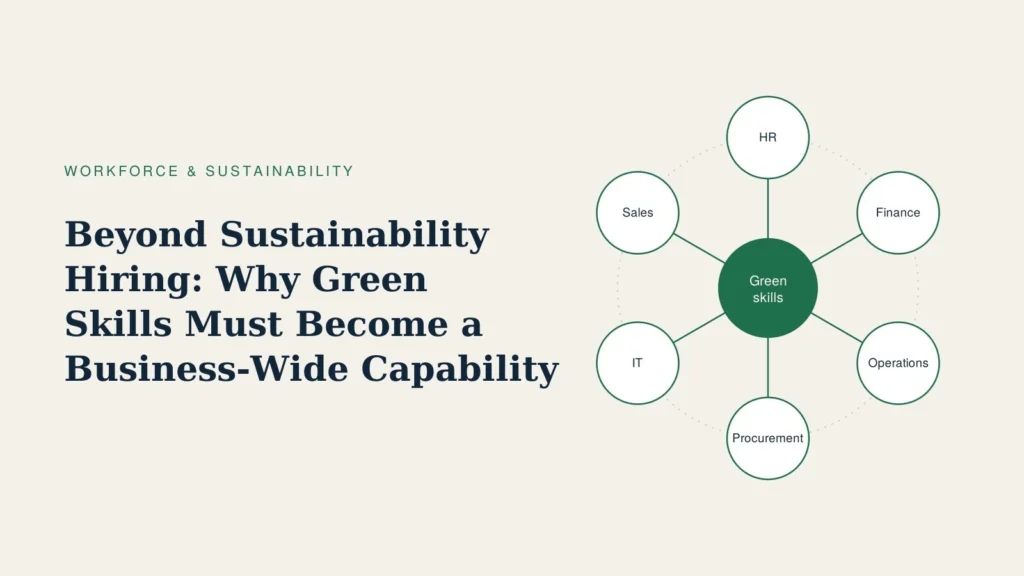
Sustainability is no longer a responsibility that can sit exclusively with environmental, ESG or corporate responsibility teams. As businesses respond to climate-related risks, changing regulations, resource constraints and new market expectations, the ability to work sustainably is becoming relevant across the entire organisation.
This shift is also changing how companies think about recruitment and workforce development. Green skills are increasingly needed in roles that may not have sustainability in their job titles, from finance and procurement to technology, operations, engineering and human resources.
According to LinkedIn’s Global Green Skills Report 2026, 74% of green hires are now entering roles without traditionally green job titles. The report also found that green hiring grew by 25% year-on-year, while the share of green talent in the workforce increased by 13%.
These findings point to an important change: sustainability is becoming a business-wide capability, not simply a specialist function.
Green Skills Are Becoming Relevant Across Departments
Green skills are often associated with environmental specialists, sustainability consultants and renewable energy professionals. However, their application extends much further.
A procurement professional may need to assess suppliers based on environmental performance. Finance teams may be involved in evaluating climate-related risks and sustainability investments. Operations teams can help reduce energy consumption, material waste and emissions. Technology teams increasingly need to consider the energy use and environmental impact of digital infrastructure.
Human resources also has an important role in identifying the skills employees need and building those capabilities into workforce planning.
LinkedIn’s 2026 report highlights this wider demand. It identifies growing demand for green skills across industries, including financial services, technology and media, and retail.
For employers, the implication is clear: sustainability-related capabilities should be considered when defining responsibilities, developing job descriptions and assessing talent across departments.
The Green Skills Gap Is a Workforce Planning Challenge
The demand for green skills is growing, but organisations cannot assume that the required capabilities are already available in their workforce.
The International Labour Organization’s Workforce 2030 report examines how green and digital transitions are influencing employment, occupational requirements and skills needs. It also highlights the importance of education, training and workforce readiness in responding to these changes.
This makes the green skills gap more than a recruitment issue. It is also a workforce planning challenge.
Businesses need to understand which roles will change, which new capabilities will be required and where existing employees may need additional training. Without this understanding, organisations may struggle to connect sustainability commitments with the practical skills needed to deliver them.
The OECD’s research on employment and skills policies for the green transition also explores the importance of reskilling, upskilling, vocational education and continuous learning in preparing workers and businesses for the transition.
For employers, this means workforce strategies should consider future skill requirements alongside business growth, operational priorities and sustainability objectives.
Recruitment Must Look Beyond Traditional Job Titles
One of the biggest opportunities for organisations is to recognise transferable skills.
A candidate does not necessarily need to have worked in a sustainability position to contribute to a company’s environmental goals. Experience in supply chain management, data analysis, energy management, process improvement, risk assessment and project delivery may provide a valuable foundation.
For example, a procurement professional with experience in supplier evaluation may be able to develop expertise in sustainable sourcing. An operations manager familiar with process optimisation may be well placed to support energy and resource efficiency initiatives.
This is why recruitment processes need to look beyond job titles and consider the actual skills candidates can bring to a role.
LinkedIn’s 2026 report reinforces this approach. Its findings show that nearly three in four green hires are entering roles without traditionally green titles. The report also highlights skills-based hiring as a way to broaden access to green talent.
Employers can respond by reviewing job descriptions, identifying essential green capabilities and recognising relevant experience from adjacent industries.
Building Green Capabilities Through Upskilling and Reskilling
External recruitment is only one part of developing a capable workforce. Organisations should also consider the potential of their existing employees.
Upskilling allows employees to strengthen their current capabilities, while reskilling prepares them to take on responsibilities in different or evolving roles. Both approaches can help businesses respond to changing skill requirements without relying entirely on external hiring.
For example, finance teams could receive training in sustainability reporting and climate-related financial considerations. Procurement professionals could develop knowledge of sustainable supply chains. Operations teams could build capabilities in resource efficiency, waste reduction and environmental performance.
The OECD’s research on skills for the green transition discusses the role of training systems, continuous learning and support for businesses in helping workers adapt to changing skill demands.
However, training should be connected to actual business responsibilities. A general sustainability awareness session may introduce important concepts, but employees also need opportunities to apply what they learn in their day-to-day work.
Organisations should therefore connect learning programmes with role-specific requirements, practical projects and measurable improvements.
HR and Sustainability Teams Need to Work Together
Building green skills across an organisation requires coordination between different business functions.
Sustainability teams understand environmental priorities and the capabilities needed to support them. HR teams understand recruitment, workforce planning, employee development and organisational structures.
When these teams work separately, sustainability requirements may not be fully reflected in hiring plans, job descriptions or learning programmes.
A more connected approach can help organisations identify current skill gaps, assess future workforce needs and develop suitable recruitment and training strategies.
Gartner’s article on building an HR operating model that succeeds in the AI era provides broader insights into how HR responsibilities, workflows and operating models are evolving. Although the article focuses on the AI era rather than sustainability specifically, its discussion of HR operating models is relevant when considering how people functions can work more effectively with other business priorities.
For sustainability capability building, HR and sustainability leaders can collaborate to:
- Identify green skills required across departments.
- Review existing employee capabilities and experience.
- Include relevant skills in recruitment criteria.
- Develop role-specific learning and development programmes.
- Track progress through workforce and business performance indicators.
This approach makes sustainability part of organisational capability planning rather than an isolated initiative.
What Businesses Can Learn from Siemens
The importance of connecting business strategy with workforce development can also be seen in industry examples.
A World Economic Forum case study on Siemens describes how the company’s EAvolve initiative supports workforce development for the energy transition.
The initiative identified 13 business-critical skills, including sustainability, environment, health and safety, artificial intelligence, data literacy, cybersecurity, digital technologies and business acumen.
According to the case study, by the end of September 2026, more than 8,000 people had engaged with the initiative, generating nearly 24,000 learning hours, including almost 3,000 hours focused on sustainability learning.
The example demonstrates how sustainability-related capabilities can be developed alongside technical and digital skills. It also shows why workforce development needs to be connected to the wider direction of the business.
Measuring Whether Green Skills Create Business Value
Developing green skills should not end with recruitment targets or employee training numbers. Organisations also need to understand whether these capabilities are contributing to business priorities.
Measurement can help leaders assess whether workforce development is translating into practical outcomes.
Depending on the organisation and its operations, useful indicators may include:
- The number of employees developing role-relevant green skills.
- Green skills included in job descriptions and recruitment assessments.
- Employee participation in sustainability-related training.
- Improvements in energy and resource efficiency.
- Reductions in material waste and operational emissions.
- Progress towards relevant sustainability targets.
These are suggested measurement areas rather than figures prescribed by the reports discussed above. Each organisation should select indicators that reflect its industry, operating model and sustainability objectives.
Connecting workforce indicators with operational performance can help businesses understand where further training, recruitment or organisational changes are needed.
Sustainability Capability Must Extend Beyond Hiring
The future of sustainability recruiting is not simply about finding more people with sustainability-related job titles. It is about understanding how green skills can strengthen the capabilities of the entire workforce.
Research from LinkedIn, the ILO and the OECD points to the growing importance of skills development, workforce readiness and broader access to green capabilities. Industry examples such as Siemens also demonstrate how organisations can connect business priorities with practical employee development.
For businesses, the next step is to bring sustainability into everyday workforce decisions: who they hire, how they develop employees, how teams collaborate and how performance is measured.
Green skills will become a lasting business capability when they are built into the way organisations operate, not treated as the responsibility of one department.
Reports and Industry Insights
The following publications and industry resources informed this article:
- LinkedIn – Global Green Skills Report 2026
- International Labour Organization – Workforce 2030: Skills for Thriving in the Green and Digital Transition
- OECD – Employment and Skills Policies for the Green Transition
- Gartner – Build an HR Operating Model That Succeeds in the AI Era
- World Economic Forum – Siemens: From Strategy to Skills: Building a Highly Skilled Workforce for the Energy Transition
The Green Skills Gap: Why Companies Are Struggling to Find Sustainability Talent