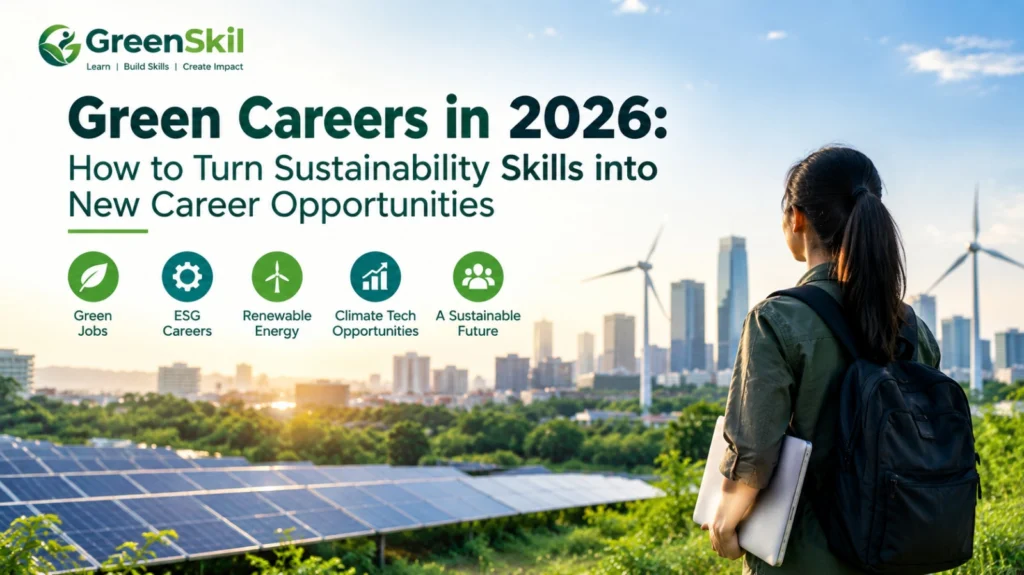
Green careers are no longer limited to environmental scientists, renewable energy engineers, or professionals working for climate-focused organisations. In 2026, sustainability knowledge is becoming relevant across business functions, including finance, procurement, operations, risk management, data, and corporate strategy.
For students, fresh graduates, and experienced professionals, this creates an opportunity to explore careers that combine existing skills with environmental responsibility and sustainable business practices.
However, building a career in sustainability is not simply about earning a certificate or applying for jobs with “green” in their titles. It requires understanding how sustainability connects with business goals, developing practical skills, and demonstrating how those skills can solve real problems.
Why Green Careers Are Changing in 2026
Sustainability has traditionally been associated with specialised teams responsible for environmental reporting, carbon emissions, regulatory compliance, and corporate responsibility. Today, these responsibilities increasingly connect with the wider operations of organisations.
Businesses need to understand climate-related risks, manage energy consumption, assess suppliers, improve resource efficiency, and respond to changing expectations from customers, investors, and regulators.
As a result, sustainability-related responsibilities can appear in job descriptions that do not explicitly mention sustainability.
For example, a procurement professional may evaluate suppliers based on environmental performance, while a finance professional may contribute to sustainability reporting or climate-risk assessments. An operations manager may focus on energy efficiency, waste reduction, or resource management.
This shift creates an important opportunity: professionals do not always need to start their careers from scratch to contribute to sustainability.
Sustainability Skills Can Open Doors Beyond Green Jobs
One of the most valuable lessons for anyone exploring a green career is that sustainability skills can be applied across different industries and professional roles.
The Green Career Digest article you referenced highlights the growing relevance of sustainability capabilities beyond dedicated sustainability teams. It also discusses findings from LinkedIn’s 2025 Green Skills Report, which indicated that green-skilled professionals were increasingly being hired into roles without sustainability-related titles.
This matters because job seekers who search only for terms such as “sustainability officer” or “ESG analyst” may overlook relevant opportunities.
Consider how existing professional experience can translate into sustainability-related work:
- Engineering: Apply technical knowledge to renewable energy, energy efficiency, cleaner manufacturing, and resource management.
- Finance and accounting: Support sustainability reporting, climate-risk analysis, responsible investment, and environmental performance measurement.
- Marketing and communications: Explain sustainability initiatives clearly and help organisations communicate environmental performance responsibly.
- Supply chain and procurement: Evaluate supplier practices, improve resource efficiency, and contribute to responsible sourcing.
- Data and technology: Analyse environmental data, support emissions tracking, and develop digital tools for sustainability management.
- Business management: Integrate sustainability considerations into planning, operational decisions, and long-term business strategy.
The goal is to recognise the connection between your existing capabilities and the problems sustainability-focused organisations need to solve.
Green Career Opportunities to Explore
Green careers span several professional areas. The most suitable pathway depends on your background, interests, and the skills you want to develop.
1. Sustainability and ESG
Sustainability and environmental, social, and governance (ESG) roles may involve sustainability reporting, environmental performance, stakeholder engagement, and corporate responsibility.
Relevant capabilities include data analysis, reporting, research, communication, and familiarity with applicable sustainability frameworks.
2. Renewable Energy and Energy Management
The transition towards cleaner energy creates work across engineering, project coordination, energy analysis, operations, and efficiency improvement.
Technical qualifications may be necessary for specialised engineering positions, while project management, analysis, and business skills can support other roles in the sector.
3. Climate Risk and Business Strategy
Organisations increasingly need to consider how environmental changes, resource constraints, and regulatory developments may affect their operations.
Professionals with analytical thinking, risk assessment, research, and strategic planning experience may find opportunities in this area.
4. Sustainable Supply Chains
Responsible sourcing, supplier engagement, materials management, and supply chain transparency connect sustainability with everyday business decisions.
Professionals with logistics, procurement, operations, and supplier-management experience may be able to build on their existing knowledge.
5. Climate Technology and Environmental Data
Digital technology can support emissions measurement, environmental monitoring, energy optimisation, and sustainability reporting.
People with backgrounds in information technology, software development, data analytics, and artificial intelligence can explore ways to apply their technical skills to environmental challenges.
These are potential career pathways rather than guaranteed job openings. Actual eligibility and required experience vary by employer and position.
How to Build a Career in Sustainability
Moving towards a green career becomes more manageable when you approach the process step by step.
Step 1: Identify your transferable skills.
Start by reviewing your education, previous roles, projects, and professional strengths. Analytical thinking, communication, project management, research, and problem-solving can be useful across many sustainability-related functions.
Step 2: Choose a specific career direction.
Instead of trying to learn every aspect of sustainability, identify an area that matches your interests. You might focus on ESG reporting, renewable energy, climate technology, sustainable supply chains, or environmental data.
Step 3: Develop practical knowledge.
Explore relevant courses, workshops, professional resources, and industry case studies. Learn how sustainability concepts are applied in real organisations. A certificate can demonstrate learning, but it does not replace practical experience or the qualifications required for a particular role.
Step 4: Build evidence of your abilities.
Create a project that demonstrates what you can do. For example, you could analyse an organisation’s publicly available sustainability report, prepare a basic energy-efficiency assessment, or build a dashboard using an appropriate environmental dataset.
Use reliable information and explain your assumptions clearly.
Step 5: Search beyond traditional job titles.
Look for relevant responsibilities within strategy, operations, finance, procurement, technology, and risk management. Read job descriptions carefully rather than relying only on the title.
Step 6: Communicate your experience in business language.
Explain how your work improves processes, supports decisions, reduces risks, strengthens reporting, or identifies opportunities. Employers need to understand the value you can contribute, not simply the sustainability terminology you know.
Why Business Skills and AI Literacy Matter
Technical sustainability knowledge is valuable, but broader business understanding can make it more useful.
Professionals who understand budgets, operational performance, financial trade-offs, and organisational priorities may be better positioned to connect sustainability objectives with business decisions.
Data literacy and familiarity with AI tools can also help professionals organise information, analyse datasets, and support research. However, generated outputs must be checked, and important decisions require sound judgement, reliable evidence, and accountability.
The strongest approach is to combine sustainability knowledge with practical skills that help organisations make informed decisions.
Common Mistakes to Avoid
Several mistakes can make a career transition more difficult:
- Collecting certificates without practical experience: Demonstrate your learning through projects and relevant work.
- Searching only for sustainability-labelled jobs: Explore related responsibilities in mainstream business functions.
- Using excessive technical terminology: Explain your capabilities in language employers outside the sustainability field can understand.
- Ignoring commercial knowledge: Learn how sustainability connects with costs, risks, operational efficiency, and business performance.
- Expecting an immediate transition: Allow time for learning, networking, applications, and conversations with professionals in your target field.
A career transition is a process, not a single decision. Your next role can be a stepping stone towards broader responsibilities and future opportunities.
The Future of Green Careers
Green careers in 2026 are not defined by one qualification, one industry, or one job title. They reflect the growing connection between environmental priorities and the way organisations operate.
For students and fresh graduates, this means exploring relevant skills early and building practical experience. For experienced professionals, it means recognising how existing expertise can support sustainability goals without necessarily abandoning an established career.
The most useful question is not simply, “How do I get a green job?” It is, “How can I use my skills to help solve a sustainability challenge?”
At GreenSkil, we believe that finding relevant learning resources, career opportunities, and professional connections should be easier. Our platform brings together sustainability-focused careers, learning opportunities, and community resources, with an AI-powered tool designed to help people find relevant sustainability solutions.
Explore GreenSkil at https://greenskil.com/ and take your next step towards a career connected to sustainability.