
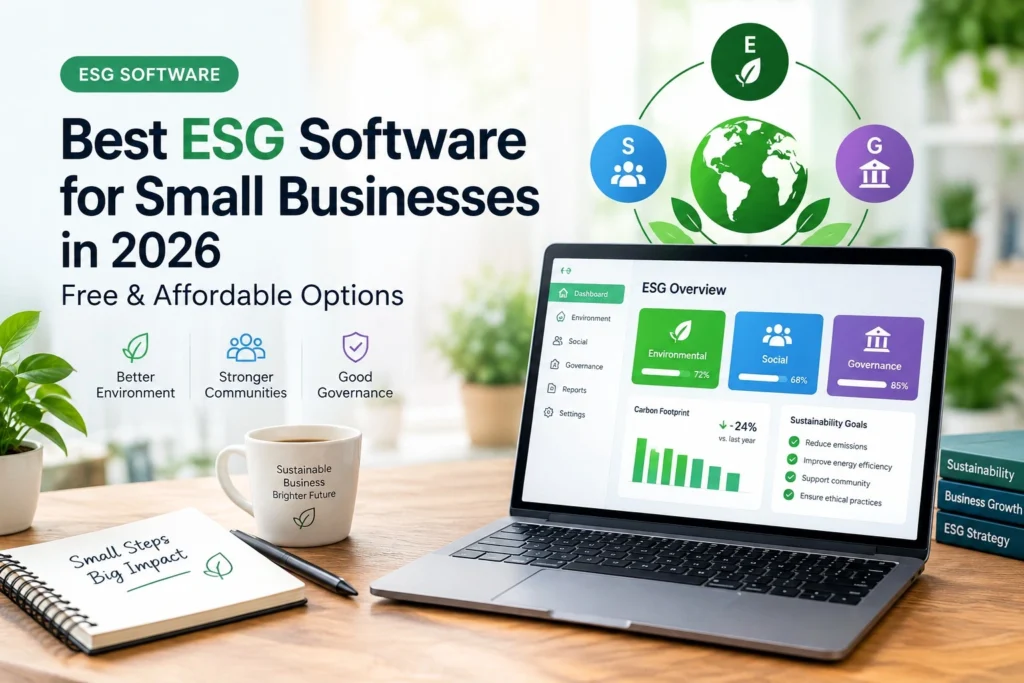
ESG software for small businesses helps companies collect, organize, track, and manage environmental, social, and governance information in one place. Instead of relying completely on spreadsheets, emails, utility bills, and separate documents, businesses can use digital tools to create a more organized approach to sustainability data.
For small businesses in the United States, ESG management does not always require expensive enterprise software. Free resources and affordable platforms can provide useful starting points for tracking energy use, greenhouse gas emissions, waste, sustainability targets, and other relevant information.
The right solution depends on the size of the business, its industry, reporting needs, available budget, and the type of ESG information it needs to manage.
What Is ESG Software for Small Businesses?
ESG software is a category of business technology designed to help organizations manage information related to environmental, social, and governance performance.
Depending on the platform, businesses may use ESG software to track:
- Greenhouse gas emissions
- Energy and fuel consumption
- Water usage
- Waste and recycling
- Renewable energy
- Supplier information
- Sustainability targets
- ESG performance indicators
- Supporting documents
- Reporting information
Some platforms focus mainly on carbon accounting, while others provide broader sustainability management, reporting, supplier management, and ESG data collection.
For a small business, the most important consideration is whether the software makes ESG management easier rather than creating another complicated system to maintain.
Why Are Small Businesses Using ESG Software?
ESG information can come from many different parts of a business. Electricity data may be found on utility bills, fuel information may be maintained by an operations team, and supplier information may be stored separately.
Managing all of this manually can become time-consuming.
ESG software can help create a centralized process for collecting and reviewing this information.
1. Centralized ESG Data
A digital platform can bring sustainability information into one location. This can make it easier for employees to find, update, and review important data.
2. Carbon Emissions Tracking
Many ESG platforms support greenhouse gas accounting and can help organizations track emissions across different categories.
The GHG Protocol provides widely used standards and guidance for corporate greenhouse gas accounting, including Scope 1, Scope 2, and Scope 3 emissions.
3. Less Manual Work
Some platforms can automate calculations or connect with other data sources. This can reduce repetitive spreadsheet work, particularly when a company has multiple facilities or reporting periods.
4. Easier Customer Reporting
Some small businesses work as suppliers to larger companies that request environmental or sustainability information. Maintaining organized ESG records can make these requests easier to handle.
5. Sustainability Goal Tracking
Businesses can use software to monitor targets related to energy, emissions, waste, water, or other sustainability indicators and review progress over time.
Free ESG Tools for Small Businesses
A small business does not necessarily need to purchase dedicated ESG software immediately.
Several established public resources can help organizations begin collecting and understanding sustainability data.
One useful option is ENERGY STAR Portfolio Manager, a free online tool from the U.S. Environmental Protection Agency. It can be used to track energy and water consumption, waste, and greenhouse gas emissions for eligible buildings.
The GHG Protocol also provides free standards and guidance that businesses can use when developing their greenhouse gas accounting processes.
These resources can be particularly useful for businesses that are still developing their sustainability programs and want to understand their data before investing in specialized software.
Affordable ESG Software: What Should You Look For?
If your business decides to purchase ESG software, focus on the features that directly support your requirements.
| Feature | Purpose |
| Carbon accounting | Track and calculate greenhouse gas emissions |
| Energy tracking | Monitor electricity and fuel consumption |
| ESG dashboards | Review sustainability performance |
| Data collection | Organize information from different sources |
| Target tracking | Monitor progress toward sustainability goals |
| Reporting | Prepare organized ESG information |
| Audit trail | Maintain records of data changes and evidence |
Not every small business needs all of these capabilities. Paying for advanced features that the company will never use can unnecessarily increase costs.
ESG Software vs. Free Tools
Free tools are often suitable for businesses with straightforward sustainability requirements.
For example, a small office may mainly need to monitor electricity and water consumption and calculate basic emissions. In this situation, free public resources combined with structured internal records may be sufficient.
A dedicated ESG platform becomes more useful when the business needs more advanced capabilities, such as automated data collection, multiple locations, supplier information, detailed carbon accounting, reporting workflows, or collaboration between different teams.
The decision should therefore be based on the company’s actual requirements rather than simply choosing the cheapest or most feature-heavy option.
How Much Does ESG Software Cost?
ESG software pricing varies considerably between providers.
Some resources are completely free, while commercial platforms may charge monthly or annual subscription fees. Pricing can depend on the number of users, locations, data sources, emissions modules, integrations, reporting capabilities, and support services.
Before purchasing a platform, small businesses should check exactly what is included in the subscription.
Important questions include:
- How many users are included?
- Are additional locations charged separately?
- Is carbon accounting included?
- Are reporting features included?
- Does the platform connect with existing business systems?
- Is implementation included?
- What level of customer support is available?
- Are advanced ESG modules charged separately?
Because software pricing can change, businesses should verify current pricing directly with the provider.
How to Choose ESG Software for a Small Business
Before selecting a platform, create a simple list of the company’s current ESG requirements.
Ask:
- What sustainability information do we currently collect?
- Which data is still maintained manually?
- Do we need Scope 1, Scope 2, or Scope 3 emissions tracking?
- Do our customers request ESG information?
- Do we need supplier sustainability data?
- How many employees will use the software?
- Do we need reporting or disclosure support?
- Can the platform maintain supporting records?
- Can it integrate with our existing systems?
- Can the software grow with the business?
It is also useful to test a platform before committing to a long-term subscription. A trial or demonstration can help employees determine whether the interface and workflow are practical.
Important Considerations for U.S. Businesses
ESG requirements can vary depending on the company’s industry, location, customers, investors, facilities, and applicable programs.
Businesses should not assume that purchasing ESG software automatically makes them compliant with every environmental or reporting requirement.
Software can help organize information and calculations, but companies remain responsible for determining which requirements apply to them and verifying information before submitting reports or disclosures.
Public resources from organizations such as the U.S. Environmental Protection Agency, ENERGY STAR, and the GHG Protocol can provide useful starting points for understanding sustainability data and greenhouse gas accounting.
Final Considerations
The right ESG software for a small business depends on what the company actually needs to measure and manage.
Businesses with basic sustainability requirements can start with free resources and structured data collection. As the amount of ESG information grows, affordable software may provide additional automation, reporting, carbon accounting, and data-management capabilities.
Before choosing a platform, compare its features, pricing, integrations, support, data-management capabilities, and scalability.
A good ESG system should make sustainability information easier to collect, understand, maintain, and report without creating unnecessary complexity for a small business.