
Sustainability has become a much bigger part of how businesses operate. Companies are setting net-zero targets, measuring carbon emissions, preparing ESG reports, and trying to understand the environmental impact of their supply chains. As a result, sustainability managers are expected to work across several areas, often with different teams and competing priorities.
But what does the job actually look like on a normal working day?
It is easy to assume that sustainability professionals spend most of their time working with advanced carbon accounting platforms, ESG software, and expensive reporting tools. These platforms certainly have their place. However, the reality is often less complicated.
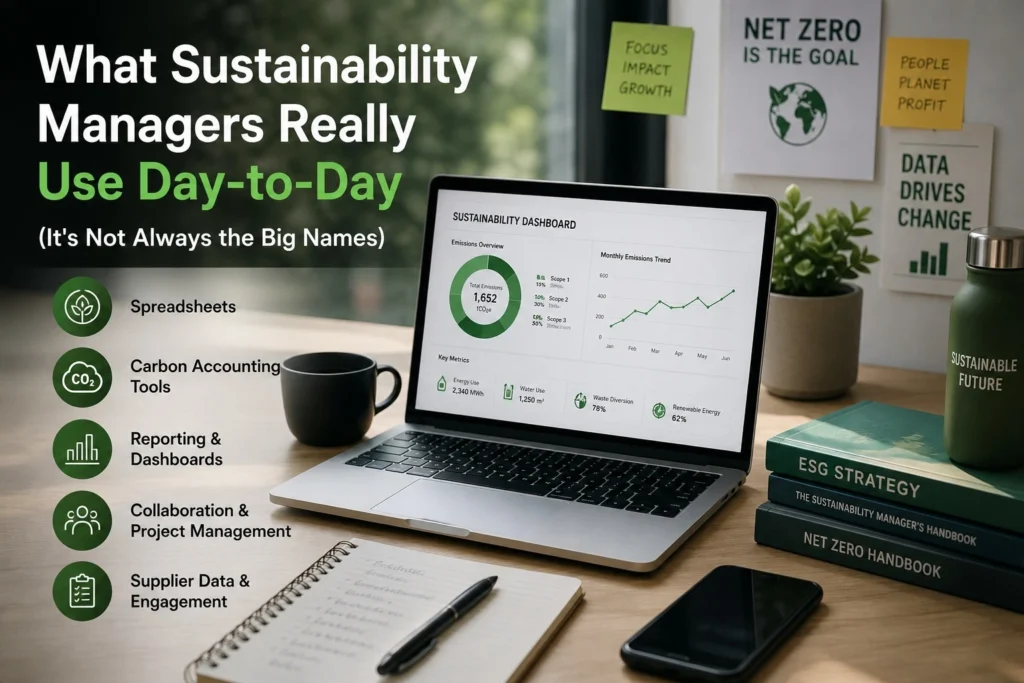
Much of the day-to-day work involves spreadsheets, shared documents, internal reporting systems, emails, and conversations with colleagues. The challenge is not always finding the most powerful software. It is finding tools that help people collect reliable information, make sense of it, and turn it into something the business can act on.
1. Spreadsheets Still Do a Lot of the Heavy Lifting
For many sustainability teams, spreadsheets remain one of the most frequently used tools.
Whether it is tracking energy consumption, collecting waste data, monitoring water usage, or maintaining a list of carbon reduction projects, spreadsheets offer a familiar starting point. They are flexible, relatively easy to share, and do not require every department to learn a new system.
A sustainability manager might use Excel or Google Sheets to compare monthly electricity consumption across offices, follow progress against emissions targets, or check whether suppliers have submitted their environmental data.
The problem begins when the process grows.
Different departments may use different formats, figures may arrive late, and teams can end up maintaining several versions of the same report. At that point, spreadsheets need better structure, clear ownership, and consistent reporting processes.
The lesson is not that spreadsheets are outdated. It is that they work best when the team understands their limitations.
2. Carbon Accounting Software Becomes Useful When Data Gets Complicated
Spreadsheets can manage a surprising amount of work, but calculating an organisation’s greenhouse gas emissions is another matter.
Businesses with multiple locations, large supply chains, and ambitious climate targets often need dedicated carbon accounting software. These platforms can help teams organise emissions data, apply emissions factors, estimate Scope 1, Scope 2, and Scope 3 emissions, and monitor progress over time.
Tools such as Watershed, Persefoni, and Greenly are examples of platforms operating in this space.
However, sustainability managers do not necessarily need an enterprise platform from day one. The right choice depends on the company’s size, reporting requirements, available data, and internal resources.
A smaller organisation may be able to manage its initial carbon footprint with spreadsheets and a clear methodology. A larger business with thousands of suppliers will probably need more structured systems.
The important question is whether the software solves a real problem. A platform is only as useful as the quality of the information going into it.
3. Reporting Tools Help Turn Data Into Something People Understand
Collecting sustainability data is one challenge. Explaining what it means is another.
Managers regularly need to prepare updates for senior leadership, provide information to clients, and demonstrate progress against environmental targets. This is where reporting and visualisation tools become valuable.
Microsoft Power BI and Tableau can help teams turn large datasets into dashboards that highlight energy use, emissions trends, waste generation, and progress against key performance indicators.
Instead of sending senior managers a spreadsheet containing hundreds of rows, a sustainability professional can present a simple dashboard showing which sites are reducing emissions and where further action is needed.
Still, not every update needs a sophisticated dashboard. Sometimes, a short presentation or a well-structured report is enough.
The aim is to make the information useful to the person receiving it, not to make the reporting process look more technical than it needs to be.
4. Shared Documents and Project Management Tools Keep Teams Moving
Sustainability work rarely sits with one person or department.
An emissions reduction project might involve facilities management, procurement, finance, operations, and external suppliers. Each group has different responsibilities, and progress can quickly slow down if nobody knows who is responsible for the next step.
Tools such as Microsoft Teams, SharePoint, Google Workspace, Asana, and Trello can help teams coordinate activities, share documents, record decisions, and track deadlines.
For example, a sustainability manager working towards a waste reduction target might use a shared tracker to assign actions to individual sites, set review dates, and record monthly results.
These tools may not be marketed specifically for sustainability, but they can be just as important as specialist ESG software.
A well-managed project tracker can sometimes solve a problem that another software subscription would simply make more complicated.
5. Supplier Data Tools Matter More Than Many Teams Expect
For businesses with extensive supply chains, collecting supplier information can become one of the most time-consuming parts of sustainability reporting.
Companies may need details about purchased materials, transportation, manufacturing processes, energy consumption, and other activities contributing to their Scope 3 emissions.
Supplier questionnaires, procurement systems, shared spreadsheets, and dedicated supply chain platforms all play a role in gathering this information.
The difficult part is that suppliers do not always have complete data ready to share. Some may lack formal sustainability reporting processes, while others use different calculation methods.
This means sustainability managers often spend time following up, checking figures, explaining requirements, and identifying gaps.
Better software can make the process more organised, but it cannot automatically create reliable data where none exists. Building relationships with suppliers and setting clear expectations remain essential.
6. The Best Tool Is Not Always the Most Expensive One
There is no single software platform that every sustainability manager needs.
A growing business might benefit most from a reliable emissions calculator and a well-maintained reporting spreadsheet. A multinational organisation may need integrated carbon accounting, supplier engagement, ESG reporting, and data management systems.
Before choosing a new tool, it is worth asking a few practical questions:
- What problem are we trying to solve?
- Where does our current process break down?
- Who will maintain the data?
- Can the tool work with our existing systems?
- Will it save time or improve the quality of our decisions?
These questions help separate genuine requirements from features that look impressive in a product demonstration but rarely get used.
It is also worth considering implementation time, staff training, data security, and ongoing costs. A tool that fits the team’s existing workflow may deliver more value than a larger platform that nobody has time to use properly.
Final Thoughts
The day-to-day work of a sustainability manager is often less about using one impressive platform and more about connecting people, data, and decisions.
Spreadsheets, shared documents, reporting dashboards, project management software, and specialist carbon accounting tools can all have a place. What matters is how well they work together and whether they help the organisation make measurable progress.
As sustainability responsibilities continue to expand, businesses will undoubtedly invest in more sophisticated technology. But buying software is only one part of building an effective sustainability function.
Good data, clear responsibilities, realistic targets, and cooperation across departments still matter enormously.
Ultimately, the best sustainability toolkit is not necessarily the one with the biggest brand names. It is the one that helps a team understand its impact, identify the next practical step, and follow through on it.