
Having spent more time looking at sustainability and ESG, one thing becomes increasingly clear: businesses rarely struggle because they do not have enough sustainability goals.
They struggle with turning those goals into something they can actually manage.
I see companies setting targets around emissions, energy, waste, responsible sourcing, reporting and climate risk. The ambition is often there. The people are there. The strategy is there.
But then comes the data.
It sits across spreadsheets, emails, supplier documents, energy bills, reporting systems and different teams.
And suddenly, something that looked straightforward becomes much harder to manage.
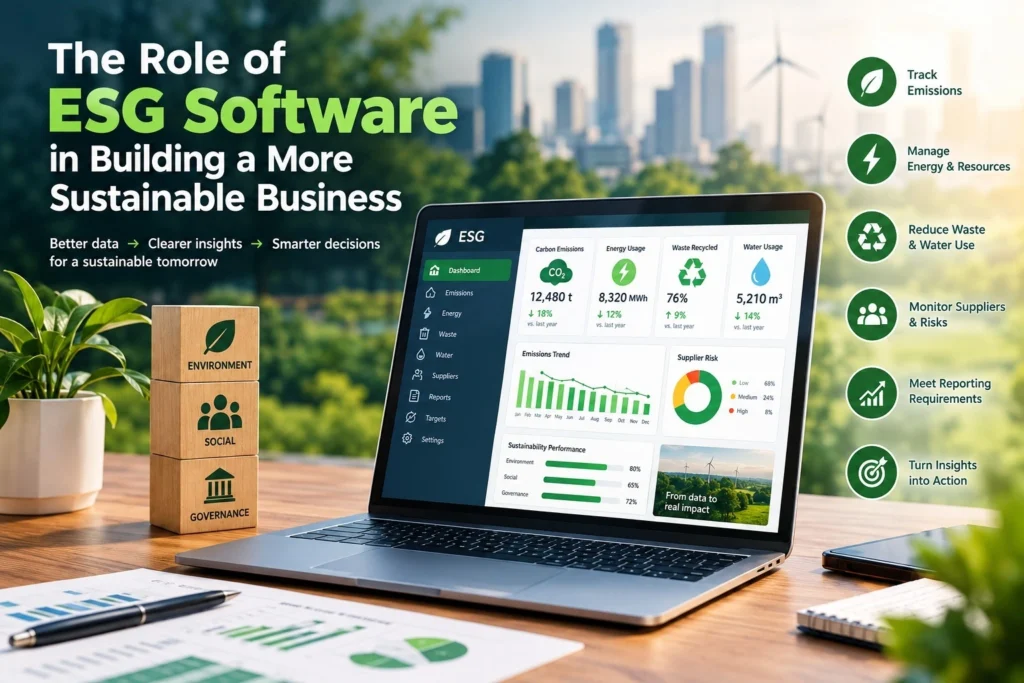
This is where ESG software can make a real difference.
The problem is not always a lack of data
Most businesses already have a surprising amount of sustainability information.
The challenge is knowing where it is, whether it is reliable, who owns it and what should actually be done with it.
One team may be collecting energy information.
Another may be working on carbon emissions.
Procurement may have supplier information.
Finance may hold business data that could help measure performance.
And the sustainability team is often expected to bring everything together.
The result?
A lot of time can be spent collecting and organising information instead of using it to make better decisions.
This is one of the reasons ESG software has become increasingly important.
So, what should ESG software actually do?
For me, the most useful way to think about ESG software is not as another reporting platform.
It should help answer a much simpler question:
Can this technology make it easier for a business to understand its sustainability performance and take action?
Good ESG software can bring different types of information into one place.
Depending on the platform and the organisation’s needs, this might include emissions data, energy consumption, waste, water, sustainability indicators, supplier information, targets and reporting requirements.
But collecting information is only the beginning.
The real value comes from being able to understand what that information is telling you.
From reporting to decision-making
There is a temptation to think about ESG software primarily in terms of reporting.
And reporting is certainly important.
Businesses may need to prepare sustainability disclosures, respond to stakeholders, track progress against targets and demonstrate how performance is changing.
But if software is only being used when a report is due, an opportunity is being missed.
The better question is:
What can we learn from the information throughout the year?
Where are emissions increasing?
Which part of the business is consuming the most energy?
Where are suppliers creating sustainability risks?
Are targets actually being achieved?
Which areas need attention first?
This is where ESG software can move from being a reporting tool to becoming a business decision-making tool.
It also changes the conversation inside a company
One of the less obvious benefits of good ESG software is that it can make sustainability easier to communicate across an organisation.
Sustainability can sometimes feel like the responsibility of one department.
The sustainability team collects information.
The sustainability team prepares reports.
The sustainability team talks about targets.
But the reality is that sustainability performance is influenced by many different parts of a business.
Operations matter.
Procurement matters.
Finance matters.
Facilities matter.
Supply chains matter.
Technology can help bring those different responsibilities into the same conversation.
Instead of asking one sustainability professional to chase information from everyone, businesses can create clearer processes around who is responsible for what.
That can make sustainability feel much more connected to everyday business activity.
But more software does not automatically mean better sustainability
This is probably the point businesses should think about most carefully.
Buying an ESG platform does not, by itself, make an organisation more sustainable.
The software still needs good data.
People still need to understand their responsibilities.
Targets still need to be realistic.
And someone still needs to make decisions based on what the information shows.
The technology should support the sustainability strategy, not become the strategy.
Before choosing an ESG platform, businesses should therefore ask themselves three simple questions:
- What sustainability problem are we actually trying to solve?
- What information do we need to manage that problem properly?
- What should better data allow us to do differently?
Those questions can prevent organisations from choosing software simply because it has the longest feature list.
The bigger opportunity
The role of ESG software is ultimately about making sustainability more manageable.
It can help businesses bring information together, improve visibility, monitor progress and identify areas that need attention.
But the real opportunity goes beyond dashboards and reports.
It is about giving people better information at the point when they need to make a decision.
Because sustainability becomes much more powerful when it moves from something that is reported once or twice a year to something that is considered as part of how a business operates every day.
The right ESG software will not solve every sustainability challenge.
But it can help businesses understand those challenges more clearly, organise the information behind them and, importantly, move from knowing what is happening to deciding what to do next.
And that may be where the real value of ESG software lies.