
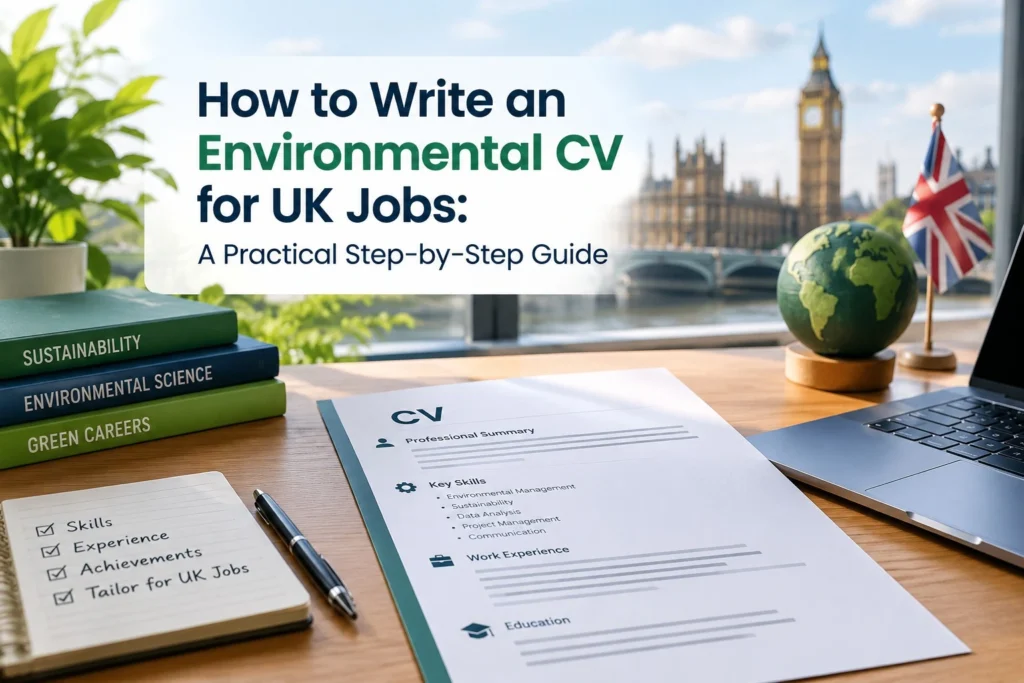
Writing an environmental CV for UK jobs is not simply about listing your degree, sustainability courses and environmental keywords.
A good CV should help an employer quickly understand what you can do, what experience you have and why that experience is relevant to the role.
This can be challenging because environmental careers cover many different areas. An Environmental Science graduate may have useful experience from fieldwork, research, GIS or a dissertation. A career changer may have transferable skills from construction, data, procurement or project management. An experienced environmental professional may have years of technical work but still struggle to show the value of that experience clearly.
The solution is not to make your CV longer.
It is to make the right evidence easier to find.
This guide explains how to build and tailor an environmental CV for UK jobs, whether you are a graduate, career changer or experienced professional.
Start With the Job, Not Your Existing CV
Before editing your CV, read the job advertisement carefully.
Look for the skills, qualifications, responsibilities and experience the employer is actually asking for.
Pay attention to areas such as:
- Environmental assessments
- Fieldwork and monitoring
- GIS and mapping
- Environmental compliance
- Sustainability reporting
- Data analysis
- Technical report writing
- Stakeholder communication
- Environmental legislation
- Project management
Then compare those requirements with your own experience.
If the vacancy asks for GIS and you have used QGIS during a university project, make that evidence visible. If it asks for report writing and you have produced technical research reports, explain that experience.
Do not add keywords simply because they appear in the vacancy.
Your CV should remain accurate.
Build a Clear Environmental CV Structure
A simple structure usually works better than an overly designed CV.
A practical format is:
- Name and contact details
- Professional profile
- Key environmental skills
- Professional experience
- Education
- Relevant projects or dissertation
- Technical skills and software
- Certifications or professional memberships
The order can change depending on your background.
For example, a graduate may place education and relevant projects higher, while an experienced professional should normally give more space to recent environmental employment.
Keep the design clean and easy to scan.
Write a Profile That Says Something Useful
Your opening profile is one of the first sections an employer will read.
Avoid statements such as:
Passionate professional looking for an exciting opportunity to develop my career.
This does not tell the employer much.
Instead, explain your background, relevant skills and career direction.
For example:
Environmental Science graduate with experience in environmental research, fieldwork, data analysis and technical report writing. Developed practical knowledge through academic projects and independent research, with an interest in environmental consultancy and environmental management.
An experienced candidate should focus on their professional expertise, sectors and key contributions.
Keep the profile concise.
Its purpose is to introduce your strongest evidence, not tell your entire career history.
Turn Responsibilities Into Evidence
One of the biggest weaknesses in environmental CVs is the use of generic responsibilities.
For example:
Responsible for environmental monitoring and reporting.
This tells the employer what the job involved, but not much about your contribution.
A stronger version could be:
Supported environmental monitoring activities, analysed collected data and contributed to technical reports for project stakeholders.
The difference is small, but the second version provides more useful information.
Where possible, structure your bullet points around:
What you did + how you did it + what it achieved.
If you have genuine measurable results, include them.
For example:
Reviewed environmental records across multiple project sites and identified recurring documentation gaps for management review.
Do not invent numbers or achievements.
Accuracy matters more than making every bullet sound impressive.
Graduates Should Use Their Academic Experience
Graduates often assume that an environmental CV requires several years of professional experience.
It does not.
Your degree can provide valuable evidence through:
- Fieldwork
- Laboratory work
- Environmental sampling
- GIS
- Research
- Data analysis
- Technical reports
- Environmental assessments
- Sustainability projects
Instead of only listing your qualification, highlight relevant academic work.
For example:
Environmental Research Project: Collected and analysed environmental data, reviewed relevant research and presented findings through a structured technical report.
This gives an employer something concrete to evaluate.
Do Not Underestimate Your Dissertation
A dissertation can demonstrate more professional skills than many graduates realise.
It can show that you can research a problem, assess information, analyse evidence, work independently and communicate findings.
Choose the parts that relate to the vacancy.
If you are applying for a GIS role, emphasise mapping and spatial analysis.
For consultancy, highlight research, assessment and report writing.
For sustainability positions, focus on the environmental problem you investigated, your analysis and the conclusions you reached.
You do not need to include your entire dissertation abstract.
Career Changers Should Focus on Transferable Skills
Changing careers does not mean starting from zero.
Previous experience can contain skills that environmental employers value.
A construction professional may have experience with site procedures, contractors, compliance, materials and waste.
A data analyst may bring experience in Excel, reporting, data quality and visualisation.
A procurement professional may understand suppliers, contracts and purchasing processes that could be relevant to sustainable procurement.
The important question is:
Which parts of my previous experience are useful for this environmental role?
Explain the connection honestly rather than trying to make your previous job sound environmental when it was not.
Make Technical Skills Specific
Avoid creating a huge list of environmental terminology.
Instead, mention technical skills that you actually use and that are relevant to the position.
For example, if you have used GIS, name the software where appropriate. If you have experience with Excel or Power BI, explain what you used them for.
Environmental roles can differ significantly.
An ecology vacancy may prioritise field surveys and ecological knowledge.
An environmental consultancy role may focus on assessment and technical reporting.
A sustainability role may place more emphasis on data, reporting and stakeholder engagement.
Tailor your technical evidence accordingly.
Should You Optimise Your CV for ATS?
Some employers use applicant tracking systems to organise and filter applications.
You can make your CV easier to process without filling it with keywords.
Use relevant terminology naturally.
If you genuinely have experience with environmental monitoring, GIS, environmental compliance or technical reporting, describe that experience using clear language.
At the same time, write for the human recruiter.
A CV packed with repeated keywords may be less convincing than one that clearly demonstrates your abilities.
What Should You Leave Off?
Your environmental CV does not need everything you have ever done.
Consider removing:
- Generic personal statements
- Repeated skills
- Unrelated old experience
- Excessive hobbies
- Very basic software skills
- Unnecessary personal information
- Unsupported claims
- Courses that have little relevance to the role
A focused CV is usually stronger than a long one filled with information that does not help your application.
A Quick Check Before You Apply
Before submitting your CV, spend a few minutes comparing it with the vacancy.
Ask yourself:
Can I see the relevant skills immediately?
Does my profile match the role?
Have I shown what I actually did?
Are my strongest environmental projects easy to find?
Have I included relevant technical skills?
Have I removed unnecessary information?
Finally, read the CV as if you were the recruiter.
After 30 seconds, could you explain what type of environmental candidate you are and what you could contribute?
If the answer is yes, your CV is doing its job.
If not, focus on making your evidence clearer rather than simply adding more content.
Frequently Asked Questions
What should an environmental CV include?
Include your contact details, professional profile, relevant skills, work experience, education and role-specific evidence such as projects, technical skills, certifications or memberships.
Can I write an environmental CV without professional experience?
Yes. Graduates can use dissertations, university projects, fieldwork, volunteering, internships and transferable skills to demonstrate relevant ability.
Should I include GIS on my CV?
If you have genuinely used GIS and it is relevant to the vacancy, include it. Where possible, mention the software and how you used it.
How long should an environmental CV be?
There is no single correct length. Keep it focused on relevant evidence. A graduate may need less space than an experienced professional with several relevant projects.
Should I use environmental keywords?
Use relevant keywords naturally when they accurately describe your experience. Avoid keyword stuffing or claiming skills you do not have.
Can AI help write an environmental CV?
AI can help improve wording, organisation and clarity, but all qualifications, skills, responsibilities and achievements should come from your real experience and be checked before submission.