
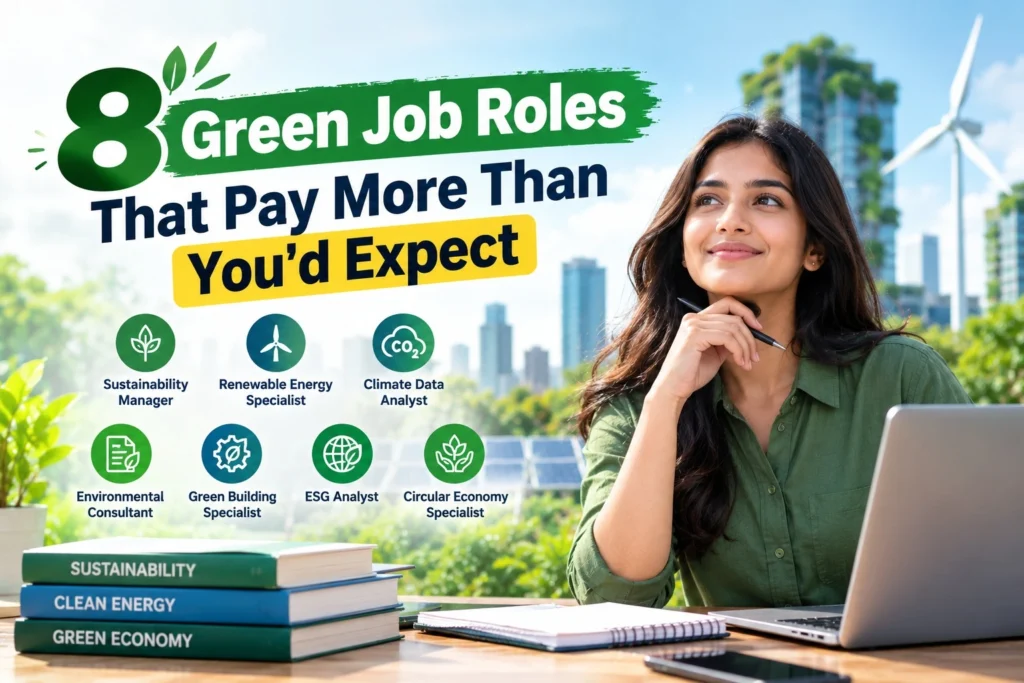
Green jobs are no longer limited to traditional environmental roles. As businesses invest in renewable energy, climate technology, sustainable operations, environmental compliance, and ESG programs, demand is growing for professionals who can combine sustainability knowledge with technical, financial, analytical, and business skills.
Some of these careers can offer significantly higher earning potential than people might expect. In particular, professionals with specialized technical expertise, industry experience, and strong business skills can find opportunities across energy, technology, consulting, manufacturing, finance, and sustainability-focused organizations.
Here are eight green job roles worth watching if you are interested in building a career around sustainability and the future of work.
1. Renewable Energy Engineer
Renewable energy engineers design, develop, test, and improve systems that generate energy from renewable sources.
Their work can involve solar power, wind energy, energy storage, grid integration, and other clean-energy technologies.
Depending on their specialization, engineers may work on:
- Renewable energy system design
- Solar and wind projects
- Battery storage systems
- Energy efficiency
- Power generation technology
- Grid-connected renewable systems
- Project testing and optimization
The role can command strong salaries because it requires a combination of engineering expertise, technical problem-solving, project knowledge, and understanding of increasingly complex energy systems.
Professionals with experience in electrical engineering, mechanical engineering, energy systems, or related technical fields can explore this career path.
2. Sustainability Manager
A sustainability manager helps an organization develop and implement strategies that reduce environmental impact while supporting business objectives.
This role has become increasingly important as companies establish sustainability targets and respond to expectations from customers, investors, employees, suppliers, and other stakeholders.
Typical responsibilities can include:
- Developing sustainability strategies
- Monitoring environmental performance
- Coordinating sustainability projects
- Supporting ESG reporting
- Managing environmental targets
- Working with suppliers
- Improving resource efficiency
- Communicating sustainability progress
Sustainability managers can earn well because the position often combines environmental knowledge with leadership, project management, communication, and business strategy.
Experienced professionals who understand both sustainability and commercial operations can be particularly valuable.
3. ESG Analyst
ESG analysts evaluate environmental, social, and governance information to help organizations, investors, or financial institutions understand sustainability-related performance and risks.
Environmental responsibilities may include analyzing:
- Greenhouse gas emissions
- Energy consumption
- Climate-related risks
- Environmental targets
- Resource use
- Sustainability disclosures
The role can also involve reviewing corporate reports, comparing ESG indicators, researching companies, checking data quality, and preparing analysis for decision-makers.
An ESG analyst with strong skills in financial analysis, data analysis, sustainability reporting, and research can progress into senior analytical, consulting, investment, or sustainability management positions.
This makes ESG analysis one of the more commercially oriented green career paths.
4. Environmental Consultant
Environmental consultants help organizations understand and manage environmental risks, impacts, and regulatory requirements.
Their work can vary considerably depending on their specialization and industry.
A consultant may work on:
- Environmental assessments
- Sustainability strategies
- Environmental compliance
- Waste management
- Water management
- Environmental risk
- Energy efficiency
- Climate-related projects
One reason experienced environmental consultants can earn more than expected is that they often work directly with organizations facing complex environmental challenges.
Specialization can also make a major difference. Professionals with expertise in environmental regulations, contaminated sites, climate risk, sustainability strategy, or specialized environmental technologies may have stronger career opportunities.
5. Carbon Accounting Specialist
Carbon accounting is becoming an important part of corporate sustainability management.
A carbon accounting specialist helps organizations measure, organize, analyze, and report greenhouse gas emissions.
The work can involve calculating emissions associated with:
- Company operations
- Purchased electricity
- Transportation
- Business travel
- Purchased goods
- Supply chains
- Waste
- Other relevant activities
Professionals may work with Scope 1, Scope 2, and Scope 3 emissions, depending on the organization and reporting requirements.
The role requires attention to detail because emissions calculations depend heavily on the quality, consistency, and documentation of underlying data.
People with backgrounds in sustainability, accounting, environmental science, data analysis, engineering, or business can potentially move into this growing specialization.
As organizations increasingly need reliable emissions data, professionals who understand both carbon accounting principles and business data systems can become highly valuable.
6. Energy Manager
Energy managers help organizations reduce energy consumption, control costs, improve efficiency, and support broader sustainability goals.
They may work across commercial buildings, manufacturing facilities, campuses, data centers, or other energy-intensive operations.
Typical responsibilities include:
- Monitoring energy consumption
- Identifying efficiency opportunities
- Managing energy projects
- Evaluating equipment performance
- Supporting renewable energy initiatives
- Tracking energy costs
- Developing energy reduction strategies
Energy management can have a direct financial impact on an organization because reducing unnecessary energy consumption can lower operating expenses.
Professionals who combine energy expertise with data analytics, engineering, project management, and financial analysis can therefore become valuable contributors to business performance.
7. Climate Risk Analyst
Climate risk analysts assess how physical and transition-related climate risks could affect organizations, assets, investments, and operations.
Physical risks may include events such as extreme heat, flooding, drought, storms, or other climate-related hazards.
Transition risks can arise as economies move toward lower-carbon technologies, policies, markets, and business models.
Climate risk analysis may involve:
- Climate data
- Scenario analysis
- Risk assessment
- Geographic information
- Financial analysis
- Corporate disclosures
- Investment research
This career is particularly interesting for professionals who enjoy combining climate science, economics, finance, statistics, and data analysis.
Because climate risk can influence long-term financial and operational decisions, the role can extend well beyond traditional environmental work.
8. Green Building & Energy Efficiency Specialist
Buildings consume significant amounts of energy and resources, creating opportunities for professionals who specialize in improving building performance.
Green building and energy efficiency specialists can work on new construction, existing buildings, renovations, energy audits, building systems, and sustainability certifications.
Their work may involve:
- Energy audits
- Building performance analysis
- HVAC efficiency
- Lighting systems
- Renewable energy integration
- Water efficiency
- Sustainable building design
- Energy benchmarking
Professionals can work with architects, engineers, property owners, facility managers, construction companies, and sustainability teams.
Specialized knowledge of building systems and energy performance can create strong career opportunities, particularly as organizations look for practical ways to reduce operating costs and environmental impact.
Which Green Jobs Have the Highest Earning Potential?
There is no single salary that applies to a green job because compensation depends on experience, location, industry, education, specialization, employer, and seniority.
However, several factors can increase earning potential.
| Career Factor | Why It Matters |
| Technical expertise | Specialized skills can be harder to replace |
| Industry experience | Experienced professionals can handle complex projects |
| Data skills | Sustainability increasingly depends on reliable data |
| Business knowledge | Companies value sustainability professionals who understand financial outcomes |
| Leadership | Management responsibilities can increase compensation |
| Regulatory knowledge | Specialized compliance expertise can be valuable |
| Technology skills | Digital sustainability tools are becoming more important |
Rather than choosing a career based only on its job title, consider the combination of skills required to succeed in that field.
Skills That Can Increase Your Value in Green Careers
The green economy increasingly rewards professionals who can connect sustainability with practical business and technical capabilities.
Some valuable skills include:
- Data analytics
- Carbon accounting
- ESG reporting
- Environmental management
- Renewable energy
- Energy efficiency
- Financial analysis
- Project management
- Sustainability strategy
- Climate risk assessment
- Technical writing
- Stakeholder communication
- Sustainability software
Digital skills can be particularly useful because many sustainability teams now work with large amounts of environmental, operational, financial, and supply-chain data.
Professionals who can interpret data and turn it into actionable recommendations may have an advantage over candidates with sustainability knowledge alone.
How to Start a Career in Green Jobs
You do not necessarily need to begin your career with a job that has the word “green” in its title.
Many professionals enter sustainability through existing fields such as engineering, finance, technology, consulting, operations, data analytics, architecture, or project management.
A practical approach is to:
- Choose a sustainability area that interests you.
- Learn the fundamentals of that sector.
- Develop one or two specialized technical skills.
- Build practical projects or a portfolio.
- Learn commonly used sustainability frameworks and tools.
- Follow developments in the green economy.
- Apply for internships or entry-level opportunities.
- Continue developing skills as the industry changes.
For example, a data analyst could specialize in sustainability data, while an engineer could move into renewable energy or energy efficiency. A finance professional could explore ESG analysis or climate risk.
This cross-disciplinary approach can make green careers accessible to people from many professional backgrounds.
Why Green Careers Are Becoming More Specialized
The sustainability sector is evolving from broad environmental initiatives toward more measurable and data-driven business strategies.
Organizations increasingly need professionals who can answer practical questions:
- How much energy are we using?
- Where are our emissions coming from?
- What climate risks could affect our operations?
- How can we reduce resource consumption?
- Which sustainability targets are realistic?
- How should environmental data be analyzed?
- How can sustainability investments create business value?
As these questions become more complex, green careers are also becoming more specialized.
This is one reason roles involving engineering, data, finance, technology, energy, and climate risk can offer strong long-term career potential.
Frequently Asked Questions
What is a green job?
A green job contributes directly or indirectly to environmental sustainability, resource efficiency, renewable energy, climate action, pollution reduction, or sustainable business practices.
Are green jobs only for environmental science graduates?
No. Green careers are available across engineering, technology, finance, data analytics, consulting, construction, operations, research, and business management.
Which green job can have strong earning potential?
Renewable energy engineering, sustainability management, ESG analysis, climate risk, environmental consulting, and specialized energy roles can offer strong earning potential, particularly with experience and specialized skills.
Do green jobs require technical skills?
Not always, but technical skills can significantly improve career opportunities. Data analysis, carbon accounting, energy systems, ESG reporting, and sustainability technology are examples of useful specializations.
Is sustainability a good career field for the future?
Sustainability is becoming increasingly integrated into business strategy, energy, technology, finance, and operations. Professionals who combine sustainability expertise with strong technical or business skills can position themselves for a wide range of career opportunities.
Final Thoughts
Green careers are becoming much broader than traditional environmental jobs. Renewable energy, sustainability management, ESG analysis, carbon accounting, climate risk, energy management, and green building are creating opportunities across multiple industries.
The most valuable professionals will not necessarily be those who know sustainability concepts alone. Strong career opportunities can come from combining green skills with data, technology, finance, engineering, communication, and business knowledge.
If you are planning a career in sustainability, focus on building a practical skill set that solves real organizational problems. That combination can make your profile more competitive as the demand for green skills continues to develop.
AI + Climate Jobs: The Future Skills Shaping the Green Economy