
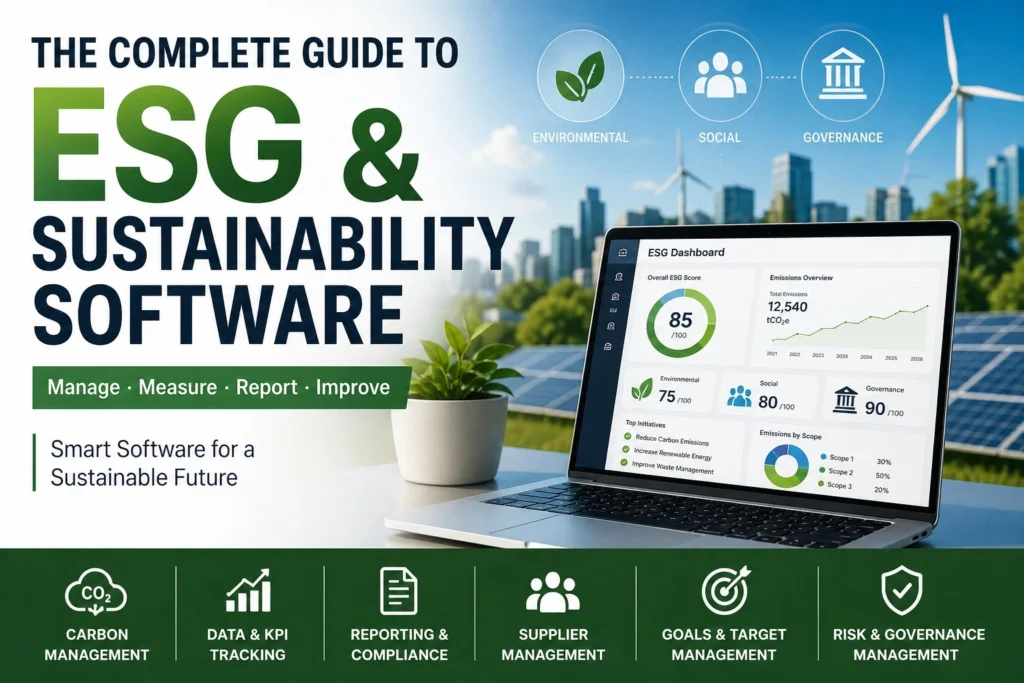
ESG and sustainability software helps businesses collect, organize, analyze, and report information about environmental, social, and governance performance. Instead of managing spreadsheets, utility bills, supplier information, emissions data, and sustainability reports separately, companies can bring much of this information into a centralized digital system.
For US businesses, these platforms are becoming increasingly useful as companies respond to customer requirements, investor expectations, internal sustainability goals, supply-chain requests, and changing reporting requirements.
But ESG software is not simply a reporting tool. The right platform can help a company understand where its environmental impact comes from, monitor progress, identify data gaps, and make better operational decisions.
What Is ESG & Sustainability Software?
ESG software is a category of business technology designed to manage sustainability and ESG-related information.
Depending on the platform, it may help organizations track:
- Greenhouse gas emissions
- Energy consumption
- Water usage
- Waste and recycling
- Renewable energy
- Supply-chain information
- Environmental targets
- Sustainability performance indicators
- ESG disclosures and reporting
- Social and governance data
- Documents and evidence used for reporting
Some platforms focus mainly on carbon accounting, while others provide broader sustainability management and ESG reporting capabilities.
For example, the GHG Protocol provides widely used standards and guidance for organizations preparing greenhouse gas inventories. Its framework covers corporate emissions accounting and reporting.
Why Are Companies Using ESG Software?
Managing sustainability information manually can become difficult as a company grows.
A business may have electricity data from one system, fuel information in spreadsheets, supplier information in another database, and environmental documents stored across different departments.
ESG software can bring these sources together and create a more organized workflow.
The main benefits can include:
1. Centralized Data
Companies can store sustainability-related information in one place rather than maintaining multiple disconnected spreadsheets.
2. Emissions Tracking
Many platforms help businesses calculate and monitor Scope 1, Scope 2, and, where applicable, Scope 3 emissions.
The EPA also provides resources for organizations working on greenhouse gas inventories, including guidance covering Scope 1, Scope 2, and Scope 3 emissions.
3. Easier Reporting
ESG software can help teams organize information required for internal reports, customer questionnaires, investor requests, and environmental disclosure programs.
4. Better Data Visibility
Dashboards can make it easier to identify trends, missing information, and areas where performance is changing.
5. Supplier and Supply-Chain Management
Larger organizations may need sustainability information from suppliers. Software can help companies collect and organize this information instead of relying entirely on email and spreadsheets.
What Features Should ESG Software Have?
The right features depend on the size and industry of the business. However, companies commonly look for the following capabilities:
| Feature | What It Can Help With |
| Carbon accounting | Tracking greenhouse gas emissions |
| Energy management | Monitoring electricity and fuel consumption |
| Scope 1, 2 & 3 tracking | Organizing emissions by source |
| Sustainability dashboards | Viewing ESG performance |
| Data collection | Gathering information from different teams |
| Supplier management | Collecting supply-chain sustainability data |
| Reporting | Preparing ESG and sustainability reports |
| Target tracking | Monitoring progress toward goals |
| Audit trails | Maintaining supporting records and evidence |
| Document management | Organizing sustainability documentation |
A useful system should not only display attractive charts. It should also make it easier to understand where the underlying data came from and who is responsible for maintaining it.
ESG Software vs. Sustainability Software
The terms ESG software and sustainability software are often used interchangeably, but they can have different focuses.
ESG software may place greater emphasis on structured reporting, governance, risk, social indicators, and environmental metrics.
Sustainability software may focus more heavily on operational areas such as energy, carbon emissions, water, waste, renewable energy, and sustainability targets.
There is considerable overlap, so businesses should evaluate software based on the actual features they need rather than the product label alone.
Important ESG & Sustainability Resources for US Businesses
Companies should also understand the public resources available before purchasing specialized software.
| Resource | Purpose | Official Source |
| U.S. EPA GHGRP | Information about US greenhouse gas reporting | EPA Greenhouse Gas Reporting Program |
| GHG Protocol | Corporate greenhouse gas accounting standards and guidance | GHG Protocol Standards |
| ENERGY STAR Portfolio Manager | Tracks energy, water, waste and GHG performance for buildings | ENERGY STAR Portfolio Manager |
| CDP | Environmental disclosure platform and questionnaires | CDP Disclosure 2026 |
The EPA says its Greenhouse Gas Reporting Program applies to certain large emitting facilities and suppliers, with reporting requirements established under federal regulations.
For commercial buildings, EPA’s ENERGY STAR Portfolio Manager can track energy, water, waste, and greenhouse gas emissions. It is also a free online tool, making it useful for organizations that are beginning to organize sustainability data.
Key 2026 ESG & Sustainability Dates to Know
Sustainability reporting timelines can vary by program and organization, so businesses should always verify dates directly with the relevant organization.
| Date / Period | Resource | What to Check |
| March 31, 2026* | EPA GHGRP | Annual reporting deadline for applicable reporters |
| 2026 | GHG Protocol | Updates to corporate accounting standards |
| 2026 disclosure cycle | CDP | Corporate environmental disclosure requirements |
| Week of October 26, 2026 | CDP | Final 2026 disclosure response deadline |
*EPA states that annual GHGRP reports are generally due March 31, moving to the next business day when the date falls on a weekend or federal holiday. Applicability depends on the facility and reporting requirements.
CDP’s 2026 disclosure cycle currently lists the final response deadline as the week of October 26, 2026, with the exact date and time to be confirmed.
What Is Changing in ESG Reporting?
The ESG landscape continues to evolve, which is one reason businesses should avoid selecting software based only on a single reporting requirement.
For example, in May 2026 the U.S. Securities and Exchange Commission proposed rescinding amendments concerning certain climate-related disclosures for registrants. The proposal was issued on May 29, 2026, and public comments were due August 3, 2026.
This is important because ESG reporting requirements can change. Businesses should therefore verify current federal, state, industry, customer, and investor requirements before treating a software platform as a compliance solution.
Software can organize data, but it does not automatically make a company compliant with every applicable law or reporting framework.
How to Choose ESG Software
Before purchasing a platform, create a clear list of your organization’s requirements.
Start by asking:
- What ESG data do we currently collect?
- Which information is stored manually?
- Do we need Scope 1, Scope 2, or Scopea 3 emissions tracking?
- Do customers or suppliers request sustainability information?
- Which reporting frameworks or questionnaires matter to our business?
- Do we need building-level energy and water tracking?
- Who will manage the data?
- Can the software maintain an audit trail?
- Can the platform integrate with our existing business systems?
- What happens if our reporting requirements change?
Small businesses may need only basic carbon and energy tracking, while larger organizations may require supplier management, automated data collection, reporting workflows, and advanced emissions accounting.