
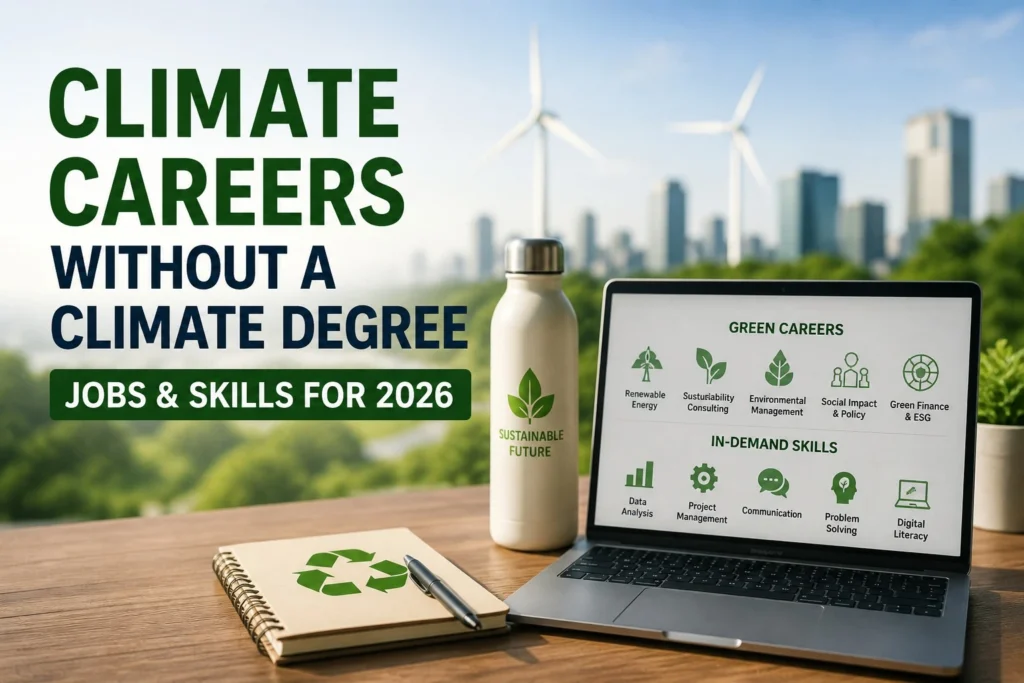
You do not need a climate science degree to build a successful career in the growing climate economy. In 2026, climate-related opportunities are expanding across renewable energy, electric mobility, sustainable finance, technology, consulting, construction, supply chains, data, communications and many other industries.
The important shift is that climate careers are no longer limited to climate scientists or environmental specialists. Companies increasingly need professionals who can combine existing business or technical expertise with knowledge of sustainability, decarbonisation, energy efficiency and climate-related risks.
This creates opportunities for graduates and professionals from engineering, finance, IT, business, marketing, operations, design, communications and other backgrounds.
Can You Get a Climate Job Without a Climate Degree?
Yes, depending on the role.
A climate-related degree can be useful for specialised positions such as climate modelling, environmental research, atmospheric science and certain scientific roles. However, many climate jobs depend more on professional skills combined with relevant climate knowledge.
For example:
- A software developer can work for a climate-tech company.
- A financial analyst can move into sustainable finance.
- A project manager can manage renewable-energy projects.
- A data analyst can work with emissions or energy datasets.
- A marketing professional can support clean-tech brands.
- A supply-chain specialist can work on sustainable procurement.
- An electrical engineer can move into renewable energy or electric mobility.
- A communications professional can work for climate-focused organisations.
The green transition is affecting multiple industries, which means climate-related skills can complement many existing career paths.
Best Climate Careers Without a Climate Degree in 2026
There is no single route into the climate sector. Your best entry point usually depends on your existing education, professional experience and transferable skills.
| Career Area | Existing Skills | Climate Skills to Add |
| Climate-Tech | IT, software, product development | Climate technology, energy systems |
| Sustainability | Business, operations, management | Sustainability, ESG, reporting |
| Renewable Energy | Engineering, project management | Solar, wind, energy systems |
| Sustainable Finance | Finance, accounting, banking | Climate risk, green finance |
| Climate Data | Data analysis, Python, statistics | Energy and environmental data |
| Green Marketing | Marketing, content, communications | Climate communication |
| Sustainable Supply Chain | Procurement, logistics | Sustainable sourcing |
| ESG & Reporting | Accounting, compliance, research | Carbon and ESG reporting |
| Energy Efficiency | Engineering, facilities management | Energy auditing |
| Climate Policy | Research, law, public policy | Climate policy and regulation |
1. Renewable Energy Careers
Renewable energy is one of the most visible areas of the climate economy.
Career opportunities exist across solar, wind, battery storage, energy efficiency, grid infrastructure, project development, operations, procurement, sales and engineering.
You do not necessarily need to become a climate scientist. Depending on the position, employers may need project managers, electrical engineers, business analysts, finance professionals, sales teams and operations specialists.
According to the International Renewable Energy Agency and the International Labour Organization, renewable energy employment reached an estimated 16.6 million jobs globally in 2024, demonstrating the scale of the sector.
For candidates without a climate degree, developing knowledge of renewable-energy technologies, project development and energy systems can complement an existing professional background.
2. Climate-Tech and Technology Jobs
Technology is becoming increasingly important to the climate transition.
Climate-tech companies need software developers, data analysts, artificial intelligence specialists, cybersecurity professionals, product managers, UX designers and cloud professionals.
Potential areas include:
- Carbon-management software
- Energy-management platforms
- Electric-vehicle technology
- Smart grids
- Climate data
- Renewable-energy software
- Battery technology
- Environmental monitoring
- Agricultural technology
- Carbon-accounting platforms
Technology professionals can therefore enter the climate sector by applying their existing technical abilities to environmental and energy-related problems.
3. Sustainable Finance and Climate Risk
Finance is another important pathway into climate careers.
Banks, investment companies, corporations and financial institutions increasingly require professionals who understand how climate-related risks and opportunities can affect businesses and investments.
Potential roles include:
- Sustainable finance analyst
- ESG analyst
- Climate-risk analyst
- Sustainability reporting specialist
- Green investment analyst
- Carbon-market analyst
A finance professional does not necessarily need to start their career again. Learning about climate risk, ESG principles, sustainable investment and carbon markets can help connect finance expertise with the growing sustainability economy.
4. Climate Data and Analytics
Climate careers are becoming increasingly data-driven.
Organisations need professionals who can collect, clean, analyse and communicate information about energy consumption, emissions, environmental performance, supply chains and climate risks.
Useful skills include:
- Excel
- SQL
- Python
- Statistics
- Data visualisation
- GIS
- Dashboard development
- Data analysis
Not every climate-data role requires advanced scientific modelling. Many positions focus on business analytics, sustainability reporting, emissions tracking and data-based decision-making.
5. Sustainability and ESG Careers
Sustainability roles can be accessible to professionals who already have business or operational experience.
Companies need people working on sustainability strategies, environmental performance, supply chains, reporting, resource efficiency and corporate sustainability programmes.
Useful skills include:
- Sustainability reporting
- ESG fundamentals
- Carbon accounting
- Stakeholder management
- Research
- Business analysis
- Project management
- Data interpretation
However, requirements vary between employers. Candidates should carefully review individual job descriptions to understand the qualifications and experience required for each position.
6. Climate Communication and Marketing
Climate action also requires professionals who can explain complex subjects clearly.
Writers, marketers, designers, public-relations professionals, social-media specialists and communications managers can work with climate-tech companies, renewable-energy businesses, consulting firms, environmental organisations and corporate sustainability teams.
Strong communication skills can be particularly valuable when organisations need to explain technical climate topics to customers, employees, investors and the wider public.
Essential Skills for Climate Careers in 2026
A strong climate career often combines one professional skill with relevant climate knowledge.
1. Climate Literacy
Understand fundamental concepts such as greenhouse gases, carbon emissions, climate risks, renewable energy, adaptation, mitigation and net-zero strategies.
2. Data Skills
Learn how to work with spreadsheets, databases, analytics tools and data-visualisation platforms.
3. Digital Skills
Digital skills are increasingly relevant to the green transition. Professionals who understand software, AI, automation, data and digital platforms can find opportunities across several climate-related industries.
4. Project Management
Climate projects often involve multiple teams, deadlines, budgets, suppliers and regulatory requirements. Project-management skills can therefore transfer well into sustainability and clean-energy roles.
5. Business Communication
The ability to write clearly, present information and communicate with different stakeholders can make technical climate knowledge much more useful in a professional environment.
6. Problem-Solving
Climate-related work frequently involves complex challenges involving energy, infrastructure, resources, finance, technology and business operations.
How to Start a Climate Career Without Going Back to College
You do not necessarily need another four-year degree to begin developing climate expertise.
Start by learning the fundamentals of climate change, renewable energy, sustainability, ESG, energy efficiency and decarbonisation.
Next, choose a specific career direction. Instead of trying to learn everything about climate, connect climate knowledge to your existing strengths.
For example:
IT + Climate = Climate-Tech
Finance + Climate = Sustainable Finance
Data + Climate = Climate Analytics
Engineering + Climate = Clean Energy
Marketing + Climate = Climate Communication
Operations + Climate = Sustainable Operations
After choosing a direction, build practical evidence of your skills. Complete a relevant project, analyse a public dataset, create a sample sustainability report, research a renewable-energy market or develop a climate-focused portfolio.
Online courses, professional certifications and industry programmes can also help, but practical knowledge and demonstrable skills should remain the priority.
How to Build a Climate Career Without a Climate Degree
A climate career does not always require a climate science degree. In 2026, professionals from technology, engineering, finance, marketing, data, operations, communications and other fields can apply their existing expertise to climate and sustainability challenges.
The most practical approach is to identify your current strengths and combine them with relevant climate skills. For example, an IT professional can move into climate-tech, a finance graduate can explore sustainable finance, a data analyst can work with emissions and energy data, and an engineer can build a career in renewable energy or electric mobility.
Start by developing a strong understanding of climate change, renewable energy, sustainability, emissions, energy efficiency and the green transition. Then choose a specific career path and build practical experience through projects, internships, certifications, online courses or portfolio work.
The demand for green skills is expanding across multiple industries, making climate careers increasingly accessible to people who do not have traditional environmental qualifications.
The key is not to start your career again from zero. Instead, combine the skills you already have with the climate knowledge employers increasingly need.