
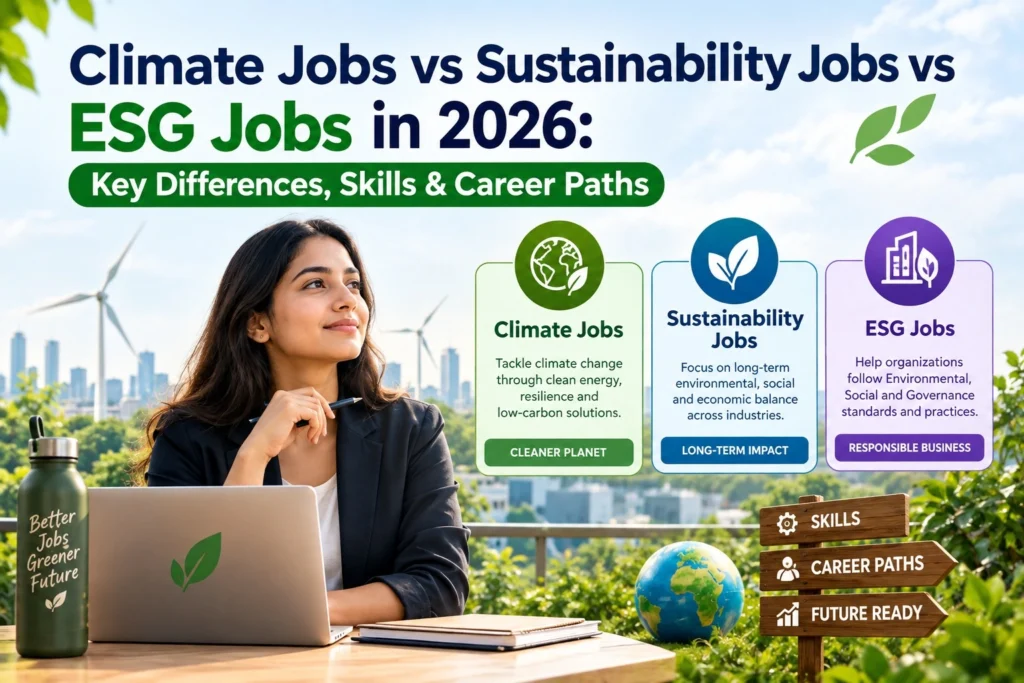
The green economy is creating career opportunities across energy, technology, finance, business, infrastructure, agriculture, and environmental services. As companies and governments respond to climate-related challenges, three career terms are becoming increasingly common: climate jobs, sustainability jobs, and ESG jobs.
Although these fields overlap, they are not exactly the same. A climate professional may focus on emissions reduction or climate adaptation, while a sustainability professional may work across environmental, social, and resource-efficiency issues. ESG professionals often focus on measuring, managing, and reporting environmental, social, and governance factors that can affect an organization.
Understanding these differences can help students, graduates, and working professionals identify the skills and career paths that match their interests.
What Are Climate Jobs?
Climate jobs are roles connected specifically to addressing climate change.
These positions can involve reducing greenhouse-gas emissions, expanding renewable energy, improving energy efficiency, developing climate technologies, analyzing climate risks, or helping organizations and communities adapt to changing environmental conditions.
Common climate-related roles include:
- Renewable energy engineer
- Climate data analyst
- Carbon management specialist
- Climate scientist
- Energy efficiency specialist
- Electric vehicle specialist
- Climate risk analyst
- Environmental engineer
- Climate technology professional
Climate careers can be highly technical and are found in sectors such as renewable energy, transportation, manufacturing, agriculture, technology, construction, and finance.
What Are Sustainability Jobs?
Sustainability jobs have a broader scope than climate jobs.
Sustainability generally involves managing environmental, social, and economic considerations so that organizations can operate responsibly over the long term.
A sustainability professional might work on energy use, waste reduction, water management, sustainable sourcing, responsible supply chains, environmental programs, employee initiatives, or corporate sustainability strategies.
Typical roles include:
- Sustainability manager
- Sustainability consultant
- Sustainable supply-chain specialist
- Energy manager
- Circular economy specialist
- Sustainable procurement professional
- Sustainability communications specialist
- Environmental program manager
Climate change can be an important part of sustainability work, but sustainability roles may cover many issues beyond climate.
What Are ESG Jobs?
ESG stands for Environmental, Social, and Governance.
ESG jobs generally involve assessing, managing, measuring, or communicating how environmental, social, and governance factors relate to an organization.
The environmental component may include emissions, energy consumption, waste, pollution, and climate risks. The social component can involve areas such as workforce practices, human rights, health and safety, and community impacts. Governance can include corporate policies, oversight, ethics, controls, and accountability.
ESG roles are common in corporate reporting, consulting, financial services, risk management, compliance, and investment-related functions.
Examples include:
- ESG analyst
- ESG reporting specialist
- ESG consultant
- ESG risk analyst
- Sustainability reporting manager
- ESG data specialist
- Responsible investment analyst
Climate Jobs vs Sustainability Jobs vs ESG Jobs
The easiest way to understand the difference is to look at the primary focus of each field.
| Career Area | Main Focus | Common Industries | Typical Work |
|---|---|---|---|
| Climate Jobs | Climate change and emissions | Energy, technology, transport, agriculture | Climate solutions, emissions reduction, adaptation |
| Sustainability Jobs | Long-term environmental and social performance | Almost every major industry | Sustainability strategy, resource efficiency, programs |
| ESG Jobs | Environmental, social and governance measurement and management | Finance, consulting, corporations | Data, risk, reporting, governance and analysis |
These categories can overlap significantly. For example, a carbon accounting professional could work within a sustainability team while also supporting ESG reporting.
Key Difference Between Climate and Sustainability Careers
The biggest distinction is scope.
Climate careers generally have a specific connection to climate change. A renewable-energy engineer designing a solar system is working directly on an energy transition challenge.
Sustainability careers can have a much wider remit. A sustainability manager may oversee energy consumption, water usage, waste, sustainable procurement, supply-chain practices, and environmental initiatives.
Therefore, someone interested specifically in climate science, clean energy, carbon reduction, or climate technology may prefer climate-focused roles, while someone interested in broader organizational sustainability may explore sustainability careers.
Key Difference Between Sustainability and ESG Careers
Sustainability and ESG are closely connected, but their day-to-day responsibilities can differ.
A sustainability professional may be responsible for implementing sustainability programs. For example, they might develop an energy-efficiency initiative or help reduce waste across company facilities.
An ESG professional may spend more time on measurement, data, risk, reporting, governance, and stakeholder requirements.
However, the distinction is not universal. Job titles and responsibilities vary between organizations, and some companies use “sustainability” and “ESG” interchangeably.
Skills Needed for Climate Jobs
Climate-focused careers often require strong technical or scientific skills, depending on the position.
Useful skills include:
- Environmental science
- Renewable energy
- Engineering
- Climate modelling
- Data analytics
- Python or R
- Geographic information systems
- Carbon accounting
- Energy management
- Research and analysis
For technical roles, specialized education or professional training may be required.
Skills Needed for Sustainability Jobs
Sustainability professionals often need a combination of business knowledge and environmental understanding.
Important skills can include:
- Sustainability strategy
- Project management
- Environmental management
- Supply-chain management
- Energy efficiency
- Circular economy principles
- Research
- Communication
- Stakeholder management
- Data analysis
Because sustainability teams work with different departments, communication and project-management abilities can be particularly useful.
Skills Needed for ESG Jobs
ESG roles can be suitable for people with backgrounds in finance, business, accounting, economics, law, data analysis, sustainability, or risk management.
Relevant skills include:
- ESG data analysis
- Financial analysis
- Risk assessment
- Corporate reporting
- Data management
- Research
- Compliance
- Sustainability reporting
- Governance principles
- Business communication
People working in ESG may also need to understand relevant reporting frameworks and disclosure requirements applicable to their employer or market.
Which Degrees Can Lead to These Careers?
There is no single degree that guarantees entry into the green economy.
For Climate Careers
Relevant backgrounds may include:
- Environmental science
- Climate science
- Engineering
- Physics
- Chemistry
- Data science
- Computer science
- Agriculture
For Sustainability Careers
Potential backgrounds include:
- Environmental science
- Engineering
- Business administration
- Economics
- Sustainability studies
- Supply-chain management
- Public policy
For ESG Careers
Commonly relevant backgrounds include:
- Finance
- Accounting
- Economics
- Business administration
- Sustainability
- Environmental science
- Risk management
- Data analytics
- Law
Professional experience can also be important, particularly for specialized corporate and financial roles.
Climate vs Sustainability vs ESG: Career Examples
Consider a company planning to reduce its environmental impact.
A climate professional might calculate emissions and develop a plan to reduce greenhouse-gas output.
A sustainability professional might coordinate the company’s broader program covering energy, waste, water, sourcing, and environmental performance.
An ESG professional might organize relevant data, assess risks, prepare disclosures, and support reporting to investors or other stakeholders.
The three professionals could therefore work on the same organizational challenge from different perspectives.
Which Career Path Is Right for You?
Instead of choosing a career based only on the job title, consider the type of work you want to perform.
If you enjoy science, engineering, technology, energy, and climate solutions, climate-focused roles may be worth exploring.
If you prefer business strategy, operations, environmental programs, resource efficiency, and organizational change, sustainability roles may be more relevant.
If you are interested in finance, data, risk, reporting, governance, and corporate analysis, ESG roles may offer a closer match.
These are not rigid categories. Many professionals move between them during their careers.
How to Build a Career in These Fields in 2026
Start with a core skill and then add sustainability or climate knowledge.
For example, a computer science graduate could develop expertise in climate data analytics. An engineering graduate could specialize in renewable energy. A finance graduate could learn ESG analysis and sustainability reporting. A business graduate could build expertise in sustainability strategy.
Practical projects can also strengthen a resume. Examples include creating a carbon-emissions dashboard, analyzing renewable-energy data, conducting an energy-efficiency study, or preparing a sample ESG report using publicly available company information.
Internships, research projects, industry certifications, and professional networking can provide additional exposure.
Career Opportunities in the USA and Global Markets
The USA has a broad range of opportunities connected with renewable energy, clean technology, corporate sustainability, environmental consulting, climate finance, and ESG-related functions.
At the same time, climate, sustainability, and ESG careers are developing across global markets. Opportunities can vary considerably depending on local regulations, industry investment, employer requirements, and economic conditions.
Job seekers should review current vacancies carefully because the same title can have very different responsibilities at different organizations.
Climate Jobs vs Sustainability Jobs vs ESG Jobs: The Bottom Line
Climate, sustainability, and ESG careers share a common connection with responsible economic development, but their primary areas of focus differ.
Climate jobs tend to concentrate on climate change, emissions, energy transition, and adaptation. Sustainability jobs generally cover a broader set of environmental, social, and operational issues. ESG jobs commonly emphasize measurement, risk, reporting, governance, and organizational performance.
For students and professionals, the best starting point is to identify an existing strength—such as engineering, coding, data analysis, finance, business, research, or project management—and connect it with climate, sustainability, or ESG expertise. This combination can open pathways into a wide range of emerging roles across the green economy.