
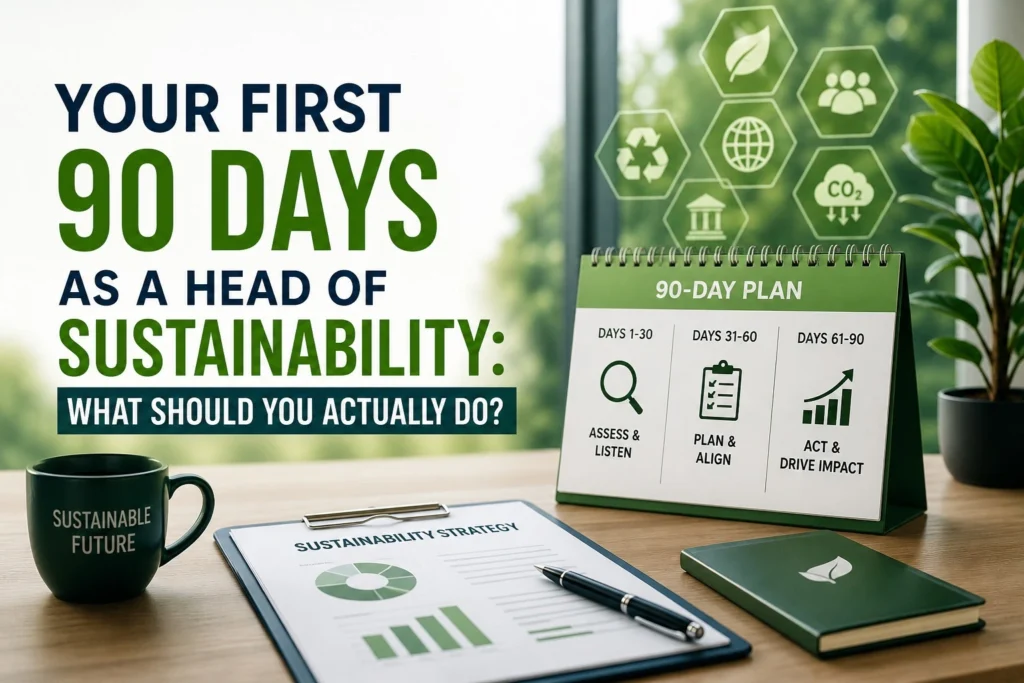
Starting a new role as Head of Sustainability can be exciting.
It can also be overwhelming.
There may already be sustainability targets, ESG reports, climate commitments, supplier programs, employee initiatives, dashboards, consultants, and a long list of things that people expect you to fix.
The temptation is to start doing.
I would resist that temptation.
If I were starting as a Head of Sustainability today, I would spend my first 90 days trying to understand the business before trying to transform it.
Here is the approach I would take.
1️⃣ Understand what already exists
Before creating a new strategy, understand the one that already exists.
What sustainability programs are currently running?
Who owns them?
Why were they created?
What has actually worked?
What has become a reporting exercise?
Speak with your sustainability team, but do not stop there.
Talk to finance, procurement, operations, HR, legal, product, sales, risk, and other teams that influence sustainability outcomes.
You are trying to understand one simple thing:
What is the organization already doing, and why?
The answer may be very different from what the sustainability strategy says on paper.
2️⃣ Understand what the business actually cares about
Sustainability priorities do not exist in isolation from the business.
Talk to senior leadership and ask what they consider important.
Then speak with the people closest to the company’s external stakeholders.
Customers may care about supply-chain emissions.
Investors may focus on risk and long-term resilience.
Employees may care about culture and purpose.
Procurement teams may be focused on supplier requirements.
Regulators may be creating entirely different priorities.
Do not assume that every stakeholder values the same thing.
Ask them.
And listen carefully to how sustainability affects actual business decisions.
3️⃣ Understand where sustainability creates value — and where it creates risk
This is where the role starts becoming strategic.
For every major sustainability issue, ask:
Is this primarily a risk, an opportunity, a compliance requirement, a cost, or a combination of these?
Some issues may create regulatory exposure.
Others may affect customer relationships.
Some may reduce operating costs.
Others may strengthen resilience or create new products and markets.
And some initiatives may simply consume resources without producing meaningful business value.
That distinction matters.
A sustainability strategy should not become a collection of activities.
It should connect sustainability priorities to decisions the business actually needs to make.
4️⃣ Look underneath the targets
Targets can look impressive.
The systems behind them are what matter.
Before committing the organization to another ambitious target, understand the baseline.
Where does the data come from?
Who owns it?
How reliable is it?
Which emissions, suppliers, facilities, products, or business units are covered?
What capabilities exist internally?
What depends on external partners?
What governance is already in place?
And perhaps most importantly:
Can the organization actually deliver what it is promising?
A target without the systems, resources, ownership, and accountability required to achieve it is not a strategy.
It is an aspiration.
5️⃣ Separate what is important from what is simply visible
Some sustainability activities receive a lot of attention because they are easy to communicate.
That does not necessarily make them the most important.
A well-designed employee campaign may generate positive engagement.
A supplier-data problem may receive almost no attention internally.
But if that supplier data affects regulatory reporting, customer requirements, or major emissions, it may deserve significantly more attention.
Do not confuse visibility with materiality.
Your job is to identify where sustainability can have the greatest impact on the business and its stakeholders.
6️⃣ Prioritize before you add more
By this point, you should have a much clearer picture.
Now make choices.
What should continue?
What should be improved?
What should be paused?
What should receive more resources?
What should the sustainability team stop doing?
This is often the uncomfortable part of the job.
There will be initiatives that people are attached to.
There will be commitments that sounded good when they were created.
There will be projects that have consumed significant time but produced limited value.
You do not need to change everything.
But you should be willing to ask whether everything still deserves to continue.
7️⃣ Build the roadmap around decisions, not activities
Once priorities are clear, build the roadmap.
But avoid creating a roadmap that simply lists dozens of projects.
Instead, connect each major initiative to a business outcome.
For example:
Problem → Action → Owner → Investment → Expected outcome → Measurement
That structure makes sustainability easier to understand outside the sustainability team.
It also makes it easier to secure leadership support.
If you need additional budget, technology, people, or organizational changes, this is where the business case becomes important.
Do not simply explain what you want to do.
Explain why the business should care.
❗ One question changes the pace: were you hired to maintain or to change?
This is one of the first things I would want to understand.
Were you hired because the existing sustainability program is performing well and needs strong leadership?
Or were you hired because leadership believes something is not working?
Those are very different situations.
If you are a maintainer, credibility may be your first priority.
Understand what works.
Protect it.
Build relationships.
Then gradually introduce improvements.
If you are a fixer, the organization may already have permission for significant change.
Leadership may expect you to challenge assumptions, redirect resources, simplify the strategy, or address problems that have been ignored.
In that situation, moving too slowly can be just as problematic as moving too quickly.
The first 90 days are not about proving you have all the answers
They are about asking better questions.
What does the business actually need?
What do stakeholders actually care about?
Where are the biggest sustainability risks?
Where can sustainability create measurable value?
What capabilities are missing?
And what needs to change first?
The strongest Heads of Sustainability are not necessarily the people who arrive with the longest list of initiatives.
They are often the people who can understand the organization quickly, identify what matters, make difficult choices, and turn sustainability into something the wider business can actually act on.