
Sustainability software is becoming an important part of how businesses measure their environmental impact, track carbon emissions, and improve ESG reporting. From small startups to large organisations, companies are looking for practical ways to understand their sustainability performance without wasting time or money.
But choosing the right software is not always straightforward. Some platforms offer free tools for basic carbon calculations and sustainability tracking, while paid solutions provide advanced reporting, automation, and supplier management.
So, is free sustainability software enough, or is it worth investing in a paid platform?
The answer depends on your business size, reporting requirements, available data, and long-term goals. Free tools can be useful for getting started, but their limitations may become noticeable as sustainability activities become more complex.
What Is Sustainability Software?
Sustainability software helps businesses collect, manage, analyse, and report information about their environmental and social performance. Depending on the platform, it may include carbon accounting, energy monitoring, waste tracking, ESG reporting, supply chain management, and sustainability target tracking.
For example, a small consultancy might use a free carbon calculator to estimate emissions from electricity consumption and employee travel. A manufacturing company, on the other hand, may need software that can monitor energy use across several facilities and collect emissions data from suppliers.
Both organisations are working towards sustainability goals, but they do not necessarily need the same software.
Understanding this difference is the first step towards choosing a platform that delivers genuine value rather than adding another unnecessary business expense.
Where Free Sustainability Software Holds Up
Free sustainability tools can be a sensible starting point, particularly for small businesses, startups, and teams that are still developing their sustainability processes.
1. Basic Carbon Footprint Calculations
Free carbon calculators can help businesses estimate emissions associated with electricity, fuel, business travel, and other common activities.
These estimates provide an initial understanding of where emissions may be coming from. A small office, for instance, might discover that electricity consumption and employee commuting are useful areas to investigate further.
However, the quality of the results depends on the information entered and the calculation methods used. Businesses with complex operations may eventually need more detailed emissions calculations and documented methodologies.
2. Simple Sustainability Tracking
Not every company needs an advanced dashboard to monitor its environmental performance.
A small business might use a spreadsheet or a free platform to track electricity consumption, paper usage, recycling rates, and business travel. When the number of metrics is limited and one person manages the process, this approach can work reasonably well.
The main advantage is flexibility. Teams can start collecting information without committing to a subscription or spending weeks configuring software.
The difficulty begins when records become scattered, several employees update different files, or reporting requires information from multiple departments.
3. Learning Before Investing
Free tools can also help businesses understand what they actually need from sustainability software.
Before purchasing a platform, a sustainability manager can experiment with different metrics, identify missing information, and learn how frequently data needs to be collected.
This preparation can make a later software investment more effective because the organisation has a clearer understanding of its requirements.
4. Small Projects and Initial Assessments
Free software may be sufficient for a short-term energy assessment, a preliminary emissions estimate, or an internal waste-management project.
If a project has a limited scope and does not require advanced reporting, a paid subscription may offer few additional benefits.
The important point is to understand the limitations of the results and avoid presenting preliminary estimates as independently verified sustainability information.
Where Free Sustainability Software Falls Short
Free tools are useful, but they may not provide everything a growing organisation needs. Their limitations often become apparent when sustainability reporting becomes a regular business responsibility.
1. Limited Reporting Capabilities
Some free platforms restrict downloadable reports, historical data, custom dashboards, or the number of metrics users can track.
This might not matter when a business simply wants to understand its approximate carbon footprint. However, companies responding to customer questionnaires or preparing regular management reports may need more structured information.
If employees repeatedly transfer data into spreadsheets to create reports, the time saved by using free software can quickly disappear.
2. Manual Data Collection
Many basic sustainability workflows depend on manual data entry. Employees must collect utility bills, fuel records, travel expenses, and supplier information before entering the relevant figures.
This creates opportunities for missing records, inconsistent units, duplicate entries, and calculation errors.
Paid platforms may offer automated data imports, integrations, validation rules, and approval workflows. These features can reduce repetitive work, although the level of automation varies between providers.
For businesses managing large amounts of information, reducing manual work can be one of the strongest reasons to upgrade.
3. Limited Supply Chain and Scope 3 Tracking
Understanding emissions from a company’s direct operations is only part of the picture. Many businesses also need to consider indirect emissions associated with purchased goods, transportation, suppliers, and other value-chain activities.
These emissions can be difficult to estimate because the required information may come from organisations outside the business.
Some free calculators provide basic estimates, but they may not support detailed supplier engagement, complex reporting structures, or extensive emissions data management.
Paid platforms may provide supplier questionnaires, emissions-factor libraries, and more detailed data-quality features. Businesses should check these capabilities carefully before purchasing.
4. Collaboration and Data Control
A spreadsheet can be manageable when one person is responsible for sustainability reporting. The situation becomes more complicated when finance, procurement, operations, and management teams all contribute information.
Paid tools may include user permissions, approval processes, audit trails, and shared dashboards. These features can make it easier to understand who entered a figure, who reviewed it, and when it was updated.
For organisations facing detailed customer reviews or formal reporting expectations, these controls may be more valuable than additional visual features.
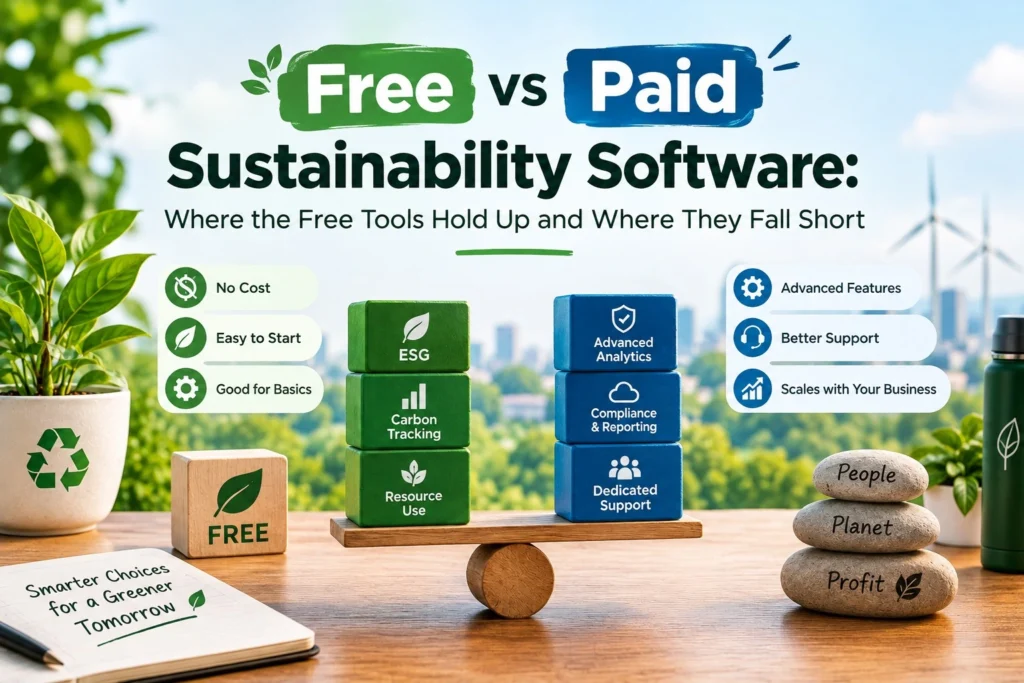
Free vs Paid Sustainability Software: Key Differences
| Feature | Free tools | Paid tools |
| Basic carbon calculations | Often sufficient | Usually available |
| Simple sustainability tracking | Suitable for smaller needs | More advanced options |
| Automated data collection | Often limited | More commonly available |
| Custom ESG reports | May be restricted | Often more flexible |
| Supplier management | Basic or unavailable | More comprehensive options |
| Multiple users | Varies by platform | Often better controls |
| Audit trails | May be limited | More likely to be available |
| Customer support | Varies | May include dedicated support |
| Cost | Free within stated limits | Subscription or licence fees |
These are general differences rather than universal rules. Some free platforms offer useful reporting features, while certain paid plans charge extra for integrations, additional users, or advanced modules.
When Is Paid Sustainability Software Worth It?
A paid platform becomes worth considering when free tools can no longer support your business efficiently.
For example, a company operating across several locations may need to combine energy consumption, fuel use, and waste data from different facilities. Managing this information manually can become time-consuming and difficult to maintain consistently.
A paid solution may also be useful when customers regularly request emissions information, management needs recurring ESG reports, or supplier data becomes a significant part of sustainability reporting.
However, a subscription alone does not guarantee accurate reporting, regulatory compliance, or independent verification. Businesses still need reliable source data, suitable methodologies, and appropriate review processes.
The decision should be based on the problems the software solves, not simply the number of features listed on its website.
How to Choose the Right Sustainability Software
Start by identifying what your business needs to measure. This could include carbon emissions, energy consumption, waste generation, water usage, or specific ESG indicators.
Next, determine where the information comes from and who will be responsible for maintaining it. If the process involves only a few straightforward metrics, a free tool may be sufficient.
If your organisation requires multiple users, automated data collection, supplier information, or recurring reports, compare paid platforms that support those needs.
Before committing, test the software with realistic data. Check whether calculations are transparent, reports can be exported, and the platform supports the methodologies relevant to your business.
Review the full cost as well. Subscription fees may not include implementation, training, integrations, extra users, or advanced reporting modules.
Finally, consider how easily you can retrieve your data if you decide to switch providers. Flexibility matters, especially when sustainability reporting becomes an ongoing business requirement.
Final Thoughts
Free and paid sustainability software serve different purposes, and neither option is automatically the better choice.
Free tools can help small businesses estimate emissions, establish tracking routines, and understand their environmental performance without an immediate financial commitment. For straightforward projects, they may provide everything that is needed.
Paid platforms become more attractive when reporting requirements expand, several teams need to collaborate, or manual data management starts consuming too much time.
The smartest approach is to begin with clear objectives, understand the limitations of each tool, and upgrade when the benefits justify the expense.
Ultimately, successful sustainability management is not about buying the most expensive software. It is about collecting reliable information, making better decisions, and turning sustainability goals into measurable progress.