
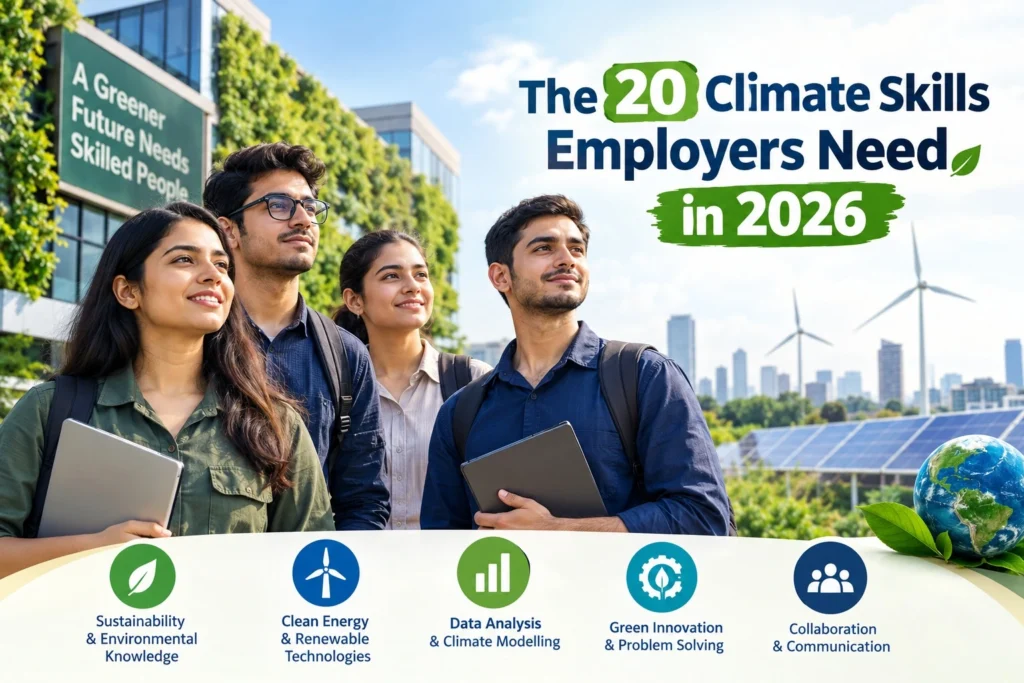
Climate change is influencing more than environmental policies and energy systems. It is also changing the way companies operate, manage risk, develop products and hire employees. In 2026, climate-related knowledge is becoming increasingly useful across industries such as technology, manufacturing, construction, finance, energy, transportation, agriculture and consulting.
For job seekers, students and working professionals, this creates an important opportunity. Climate skills do not necessarily mean starting an entirely new career. In many cases, professionals can combine climate knowledge with the skills they already have.
The World Economic Forum’s Future of Jobs Report 2025 identified environmental stewardship among the skills expected to become increasingly important, alongside analytical thinking, technological literacy, creativity, resilience and lifelong learning.
So, what climate skills should professionals develop in 2026? Here are 20 areas worth understanding.
1. Climate Risk Assessment
Climate risk assessment involves identifying how climate-related events could affect businesses, infrastructure, communities and investments. Professionals may evaluate risks associated with extreme heat, flooding, drought, storms or water shortages.
This skill is particularly relevant to consulting, insurance, finance, infrastructure and corporate risk management.
2. Carbon Accounting
Carbon accounting is the process of measuring and organizing greenhouse gas emissions. Companies use emissions information to understand their environmental impact and support sustainability programs.
Professionals with accounting, finance, data or business backgrounds can add carbon accounting knowledge to their existing skill set.
3. Greenhouse Gas Measurement
Understanding how greenhouse gas emissions are calculated is another valuable climate skill. This can include learning about emissions sources, measurement methods, reporting boundaries and basic emissions data management.
Manufacturing, energy, transportation and consulting organizations can all require professionals who understand environmental data.
4. Sustainability Reporting
Businesses increasingly publish sustainability-related information for investors, customers, regulators and other stakeholders.
Sustainability reporting requires strong research, documentation, data management and communication skills. Professionals who can turn complex environmental information into clear reports can contribute to corporate sustainability teams.
5. Environmental Data Analysis
Climate and environmental work depends heavily on data. Professionals may work with energy consumption, emissions, weather, water usage, waste or other environmental datasets.
Skills in Excel, statistics, dashboards, data visualization and analytical software can therefore complement climate knowledge.
For students, learning basic data analysis alongside sustainability concepts can be a practical starting point.
6. Renewable Energy Knowledge
Solar power, wind energy, battery storage and other clean-energy technologies are transforming energy systems.
Not everyone working in renewable energy needs to be an engineer. Project managers, analysts, finance professionals, sales specialists, operations teams and communication professionals can also work in the sector.
Understanding basic renewable-energy concepts can therefore open additional career pathways.
7. Energy Efficiency
Energy efficiency focuses on reducing unnecessary energy consumption while maintaining the required performance of buildings, factories, equipment and systems.
Professionals can use energy audits, monitoring systems and efficiency strategies to identify opportunities for reducing energy use.
This skill can be useful in engineering, construction, manufacturing, property management and facilities operations.
8. Life Cycle Assessment
Life Cycle Assessment, commonly called LCA, examines environmental impacts associated with different stages of a product or service.
It can consider activities such as raw-material extraction, manufacturing, transportation, use and disposal.
LCA knowledge can be useful for professionals working in product development, manufacturing, packaging and sustainability.
9. Circular Economy
The circular economy focuses on keeping products and materials useful for as long as possible.
Instead of relying only on a traditional make-use-dispose model, businesses can explore reuse, repair, recycling, refurbishment and remanufacturing.
Professionals who understand circular business models can contribute to product development, waste reduction and sustainable supply-chain initiatives.
10. Climate Adaptation
Climate action is not only about reducing greenhouse gas emissions. Organizations also need to prepare for climate-related risks.
Climate adaptation can involve improving infrastructure, preparing communities for extreme weather, protecting water resources and strengthening business continuity plans.
This skill can be relevant to urban planning, construction, agriculture, infrastructure, government and risk management.
11. Environmental Compliance
Companies operating in environmentally sensitive industries need to understand applicable environmental requirements.
Environmental compliance may involve permits, documentation, monitoring, reporting and regulatory procedures.
Professionals who understand both business operations and environmental requirements can help organizations manage these responsibilities more effectively.
12. Sustainable Supply Chain Management
Climate considerations increasingly extend beyond a company’s own facilities.
Businesses may examine transportation, suppliers, raw materials, packaging, logistics and resource consumption throughout their supply chains.
Sustainable supply-chain professionals can help organizations identify environmental risks while maintaining operational and commercial objectives.
13. Water Resource Management
Water is an important environmental and business issue. Agriculture, manufacturing, utilities, construction and communities all depend on reliable water resources.
Water-management skills can include understanding water efficiency, conservation, quality monitoring and resource planning.
Professionals working in environmental science, engineering and infrastructure can benefit from this knowledge.
14. Waste Management and Recycling
Waste reduction remains an important part of environmental management.
Businesses and communities need professionals who understand waste collection, recycling, resource recovery, material efficiency and responsible disposal.
Knowledge of waste management can be useful in manufacturing, municipal services, construction, hospitality and environmental consulting.
15. GIS and Climate Mapping
Geographic Information Systems, or GIS, are widely used to analyze location-based information.
GIS can help professionals map environmental risks, infrastructure, natural resources, land use and climate-related hazards.
Learning basic GIS tools can be particularly valuable for students interested in environmental science, geography, urban planning, disaster management or infrastructure.
16. Climate Policy Knowledge
Climate policies can influence energy, transportation, construction, manufacturing, finance and other industries.
Professionals do not necessarily need to become policy experts. However, understanding how climate policies and regulations affect organizations can be valuable.
This skill can support careers in consulting, government, research, corporate affairs and sustainability.
17. Sustainable Finance
Climate issues are increasingly connected with financial decisions.
Banks, investors and companies may consider environmental risks, sustainability strategies and long-term resource challenges when making business decisions.
Professionals with finance backgrounds can explore sustainable finance, climate-risk analysis, carbon markets and sustainability-related investment concepts.
18. Green Project Management
Climate and sustainability projects still require strong project-management skills.
Whether the project involves renewable energy, energy efficiency, sustainable construction or environmental technology, organizations need people who can manage budgets, timelines, teams, suppliers and deliverables.
Project management combined with climate knowledge can therefore be a useful professional combination.
19. Climate Technology Literacy
Technology is becoming an important part of climate-related work.
Organizations are using sensors, digital monitoring systems, data platforms, artificial intelligence, automation and energy-management technologies to collect and analyze environmental information.
The World Economic Forum has identified AI and big data, networks and cybersecurity, and technological literacy among the technology-related skills expected to grow in importance.
Professionals do not necessarily need to become advanced programmers. Understanding how climate technology works and how data can be used can already provide value.
20. Communication and Stakeholder Engagement
Technical knowledge alone is not enough.
Climate professionals often need to explain complicated information to managers, customers, employees, policymakers, investors or communities.
Strong writing, presentation, teamwork and communication skills can therefore make technical climate expertise much more useful.
This is especially important because sustainability projects often involve people from different professional backgrounds.
Why Climate Skills Matter Across Different Careers
One important trend in 2026 is the combination of climate skills with existing professional abilities.
An engineer could add renewable-energy or energy-efficiency expertise. A finance professional could learn carbon accounting or sustainable finance. A data analyst could specialize in environmental datasets. A project manager could move into renewable-energy or sustainability projects.
This means professionals do not always need to choose between their current career and climate-related work.
Instead, they can build a combination of skills.
The U.S. Bureau of Labor Statistics describes green jobs broadly, including jobs that produce environmental goods and services as well as positions where workers make business processes more environmentally friendly or use fewer natural resources.
The agency also projects employment of environmental scientists and specialists to grow by 6% from 2025 to 2035, compared with 3% for all occupations. It estimates around 7,300 openings per year on average for environmental scientists and specialists during that period.
These figures apply specifically to the U.S. environmental scientist occupation and should not be treated as a forecast for every climate-related job.
How Students and Job Seekers Can Build Climate Skills
Learning all 20 skills at once is neither necessary nor practical.
A better approach is to select a few skills that match your existing education or career goals.
For example, an engineering student could begin with renewable energy, energy efficiency and project management.
A commerce or finance graduate could explore carbon accounting, sustainability reporting and sustainable finance.
A computer science graduate could combine data analysis, artificial intelligence and environmental datasets.
A student interested in government or public policy could study climate policy, environmental compliance and climate adaptation.
Practical projects can also strengthen a resume. A candidate could create a simple carbon-footprint analysis, prepare a sustainability report for a hypothetical company, analyze energy-consumption data or build a basic climate-risk map using GIS.
These projects demonstrate how knowledge can be applied rather than simply listing climate-related keywords on a resume.
Where to Find Reliable Climate and Career Information
Job seekers should rely on official and established sources when researching climate careers and skill requirements.
The U.S. Bureau of Labor Statistics provides information about occupations, employment projections, wages and career requirements.
The World Economic Forum publishes research on future skills and changing workforce trends.
The International Labour Organization provides research on skills development and the transition toward more sustainable economies.
For readers in India, government resources such as NITI Aayog and Skill India can also provide information related to workforce development and emerging skills.