
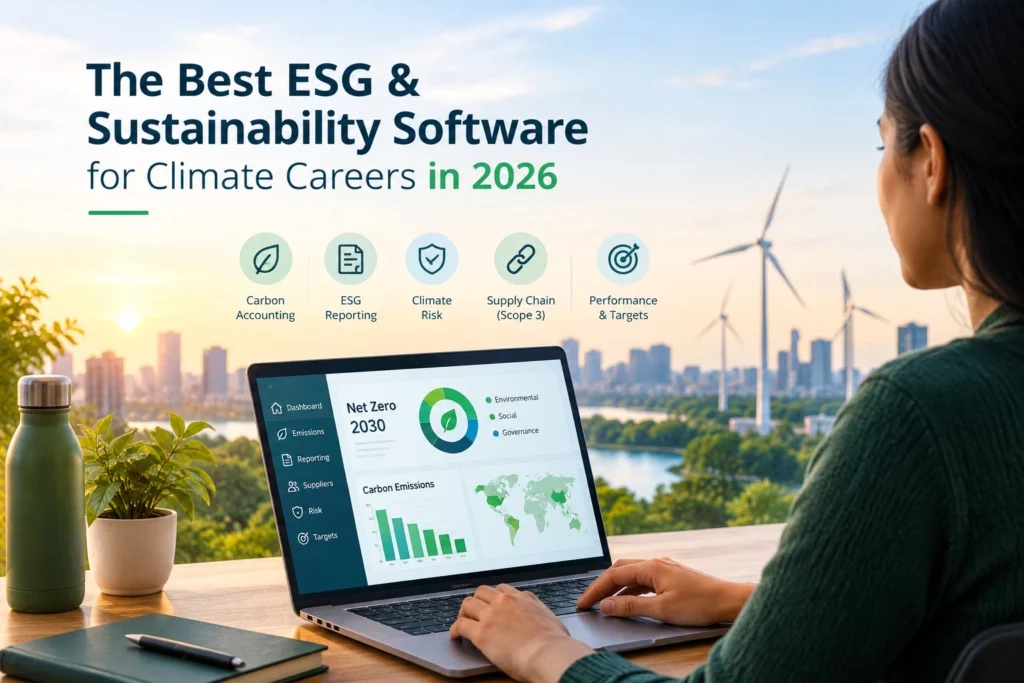
Working across sustainability, ESG and climate careers, one thing has become increasingly clear: understanding sustainability data alone is no longer enough. Professionals also need to know how that data is collected, managed, analysed and translated into meaningful business decisions.
That is where ESG and sustainability software is becoming increasingly important.
Companies today are managing emissions, energy use, supply-chain information, climate risks, ESG reporting, sustainability targets and regulatory requirements. As these responsibilities grow, organisations need better systems to manage the information behind their sustainability strategies.
For climate professionals, this creates an interesting career opportunity.
You do not necessarily need to become a software specialist. But understanding how sustainability technology works — and how businesses actually use it — can make you more effective in a climate or ESG role.
Why ESG Software Matters for Climate Careers
A common misconception is that ESG software is simply designed to help companies prepare sustainability reports.
The reality is broader.
Modern sustainability platforms can help organisations collect environmental data, calculate emissions, monitor targets, assess risks, manage suppliers and track ESG performance.
For professionals entering climate careers, this means technology is becoming part of everyday sustainability work.
The important question is not simply, “Which software should I learn?”
It is:
“Which sustainability problems can this technology help a business solve?”
1. Carbon Accounting Software
Carbon accounting is one of the most important areas for climate professionals to understand.
Companies need to measure greenhouse gas emissions across Scope 1, Scope 2 and Scope 3. This can involve large amounts of information from energy consumption, fuel use, transportation, suppliers and other business activities.
Carbon accounting platforms help organisations collect this information, apply relevant emissions factors and calculate their overall carbon footprint.
For climate professionals, understanding these platforms can be particularly useful when working in:
- Carbon management
- Net-zero strategy
- Sustainability consulting
- ESG reporting
- Climate strategy
But knowing how to operate the software is only part of the skill.
Professionals also need to understand where the data comes from, how reliable it is and what assumptions have been made.
2. ESG Reporting Platforms
ESG reporting can quickly become complicated.
Information may come from finance, HR, operations, procurement, environmental teams and external suppliers. Bringing all of this together can be difficult when information is stored across different spreadsheets and systems.
ESG reporting platforms help create a more structured way of managing this information.
For sustainability professionals, experience with ESG reporting technology can help develop a better understanding of how sustainability metrics are collected, reviewed and communicated.
It also reinforces an important lesson:
Good sustainability reporting starts with good sustainability data.
3. Sustainability Data Management Tools
One of the biggest challenges facing sustainability teams is not a lack of data.
It is often the opposite.
There can be too much information, stored in too many places.
Energy consumption may sit with facilities teams. Supplier information may be managed by procurement. Waste information may come from external providers, while emissions calculations may be maintained separately.
Sustainability data management platforms can help bring these different sources together.
For climate professionals, this makes data literacy increasingly valuable.
Being able to organise, validate and interpret sustainability information can be just as important as understanding sustainability concepts.
4. Scope 3 and Supply Chain Platforms
Scope 3 emissions remain a major challenge because many of the relevant activities happen outside a company’s direct operations.
Purchased goods, transportation, business travel, suppliers and product use can all contribute to an organisation’s emissions footprint.
Supply-chain sustainability software can help companies collect supplier information, monitor performance and identify areas where sustainability improvements may be needed.
This makes the technology particularly relevant for professionals working in:
- Sustainable procurement
- Supply-chain sustainability
- Supplier engagement
- Scope 3 management
- Climate strategy
The real career advantage comes from understanding how supplier data can support better business decisions.
5. Climate Risk and Scenario Analysis Software
Climate careers are also moving beyond carbon accounting.
Companies increasingly need to understand how climate change could affect their operations, assets and long-term strategy.
Climate risk platforms can support analysis of physical risks such as extreme weather, as well as transition risks linked to policy changes, technology, markets and the move towards a lower-carbon economy.
For professionals interested in climate risk, sustainability strategy, finance or resilience, this is an area worth exploring.
The valuable skill is being able to connect climate information with business risk.
6. ESG Performance and Target-Tracking Tools
Setting a sustainability target is one thing.
Tracking whether the organisation is actually moving towards it is another.
ESG performance platforms allow organisations to monitor indicators and compare progress against sustainability objectives.
This can include areas such as emissions, energy, water, waste and other environmental or social metrics.
For climate professionals, these systems demonstrate the difference between setting ambitious goals and delivering measurable progress.
A net-zero commitment, for example, needs more than a public announcement. It requires data, milestones, accountability and continuous monitoring.
What Should Climate Professionals Learn in 2026?
You do not need to become an expert in every ESG software platform.
Instead, focus on understanding the fundamentals.
Learn how carbon accounting works. Understand Scope 1, 2 and 3 emissions. Develop strong spreadsheet and data-analysis skills. Learn how ESG metrics are collected and reported. Understand how sustainability targets are measured.
Then explore a few major software categories and see how they approach these challenges.
The goal should not be to collect as many software certifications as possible.
The goal is to become a professional who can use technology to solve real sustainability problems.
The Bigger Career Opportunity
The sustainability profession is changing.
Companies are increasingly looking for professionals who can connect sustainability with data, technology, finance, operations and business strategy.
That creates opportunities for people who can do more than understand climate terminology.
The strongest climate professionals may be those who can look at a complex sustainability problem, identify the right information, use appropriate technology and turn the results into a practical business decision.
That is why ESG software knowledge can become an important career advantage in 2026.
ESG software is not replacing sustainability professionals. It is changing what effective sustainability professionals need to know.
For anyone building a career in climate and sustainability, learning how these tools work could be one of the most practical ways to stay relevant as the profession continues to evolve.