
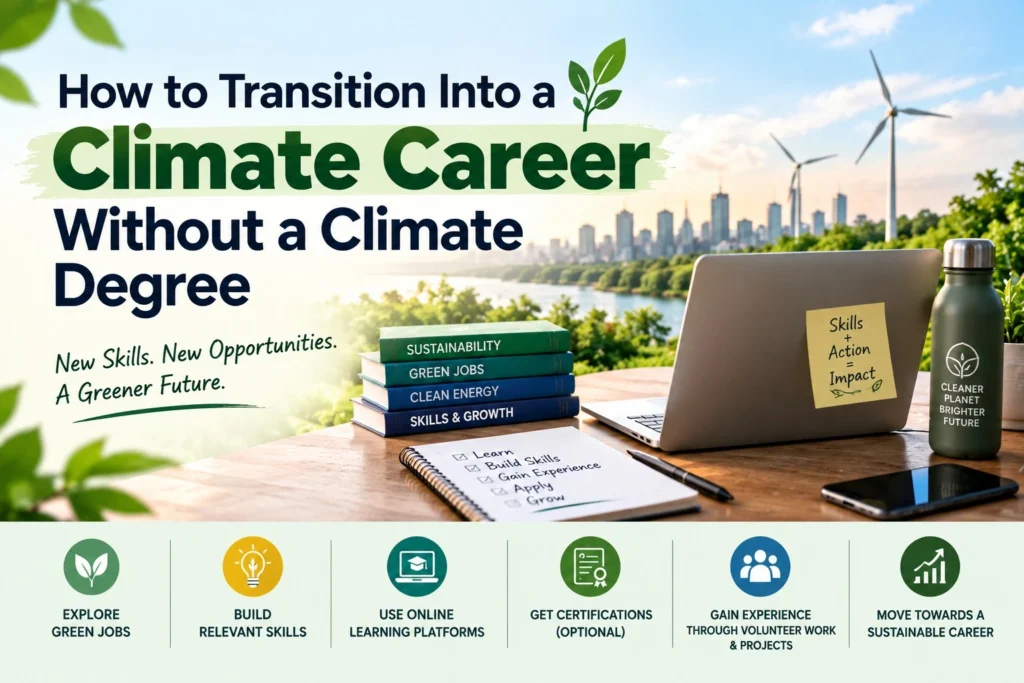
The climate economy is creating new opportunities across energy, technology, finance, transportation, manufacturing, construction, consulting, and many other industries. As companies invest in cleaner technologies, reduce emissions, improve energy efficiency, and respond to environmental risks, demand is growing for professionals with a wide range of skills.
Yet many people hesitate to pursue climate-related careers because they assume they need a degree in climate science, environmental science, or a related field.
A climate-specific degree is not always required.
Professionals from technology, finance, engineering, marketing, communications, operations, human resources, project management, and other backgrounds can build successful careers in the climate sector. The key is learning how your existing expertise can contribute to climate-related challenges and then developing the knowledge employers expect.
What Is a Climate Career?
A climate career can involve much more than studying the environment or conducting scientific research.
Climate-focused organizations need professionals who can develop technology, manage projects, analyze data, raise capital, build products, communicate with customers, manage supply chains, and operate businesses.
Potential career areas include:
- Renewable energy
- Clean technology
- Energy efficiency
- Electric transportation
- Sustainable finance
- Climate consulting
- Environmental data and analytics
- Corporate sustainability
- Sustainable supply chains
- Green construction
- Climate technology
- Carbon management
- Environmental communications
- Climate policy and research
This broad range of opportunities means your existing professional background may already be useful.
For example, a software developer could work on climate-data platforms, while a financial analyst could move into sustainable finance. A project manager could support clean-energy projects, and a marketing professional could work for a climate technology company.
Start With the Skills You Already Have
The first step is not necessarily going back to school. Instead, take an honest look at the skills you already possess.
Focus on transferable skills rather than simply looking at your current job title.
A finance professional may already understand financial modeling, budgeting, investment analysis, and risk management. Those skills can be relevant to clean energy, sustainable finance, and climate-focused investment.
A technology professional may have experience with software development, data analysis, artificial intelligence, cloud computing, or cybersecurity. These capabilities can be valuable in climate technology.
Similarly, professionals in sales, marketing, communications, operations, human resources, and project management can apply their existing expertise to climate-related organizations.
The objective is to build on your current experience rather than starting your career from scratch.
Develop Climate Knowledge Without Earning Another Degree
You can build a strong foundation in climate-related topics without necessarily pursuing another traditional degree.
Start by understanding the fundamentals of the field, including greenhouse gas emissions, renewable energy, energy efficiency, decarbonization, climate risk, climate adaptation, carbon accounting, and the energy transition.
Online courses, professional training programs, industry publications, webinars, workshops, and reputable educational resources can help you develop this knowledge.
However, simply collecting certificates may not be enough.
Employers also want professionals who can apply knowledge to real-world problems. Instead of focusing only on how many courses you can complete, think about what problems you can solve with the knowledge you gain.
For example, you could learn how to analyze energy consumption, evaluate a clean-energy business model, interpret sustainability data, or identify opportunities to reduce emissions within an organization.
Choose a Specific Climate Career Path
Climate is a broad field, so trying to learn everything at once can make your transition difficult.
Instead, identify one area that connects your existing skills with a climate-related opportunity.
If you have a technology background, explore climate software, environmental data, energy analytics, artificial intelligence, or digital solutions for the energy sector.
If you have finance experience, consider sustainable finance, climate-risk analysis, clean-energy project finance, or investment research.
Engineers may explore renewable energy systems, batteries, electric transportation, energy efficiency, or sustainable manufacturing.
Marketing and communications professionals can look at sustainability communications, clean-technology marketing, public engagement, and corporate sustainability.
Operations professionals may find opportunities in sustainable procurement, supply-chain decarbonization, energy management, and environmental operations.
Choosing a niche gives your career transition a clear direction while still allowing you to change paths later.
Gain Practical Climate Experience
Knowledge becomes more valuable when you can demonstrate how you use it.
Look for opportunities to gain practical experience through projects, internships, freelance work, volunteering, research, or responsibilities within your current organization.
You could analyze publicly available sustainability data, create a climate-data dashboard, research renewable-energy markets, develop a carbon-reduction proposal, or study the business impact of energy-efficiency improvements.
These projects can become part of a professional portfolio.
A portfolio can be particularly valuable when you are changing careers because it gives employers tangible evidence of your ability to apply your skills to climate-related challenges.
Use Your Current Job as a Bridge
You do not necessarily have to leave your current career immediately.
Look for climate-related projects within your existing organization.
For example, a finance employee could contribute to sustainability reporting. An operations professional could participate in an energy-efficiency initiative. A software developer could help build an internal environmental-data system.
This approach allows you to gain relevant experience while continuing in your current position.
It also gives you a stronger story when applying for future opportunities because you can demonstrate actual climate-related work rather than simply saying that you are interested in the field.
Update Your Resume for Climate Roles
Your resume should clearly connect your existing experience with the requirements of the climate positions you are targeting.
Instead of focusing only on job titles, highlight accomplishments and transferable skills.
For example, rather than simply writing that you are a project manager, explain how you managed budgets, coordinated teams, improved processes, delivered projects, or reduced operational costs.
Then connect those capabilities to climate-related roles where project management and operational expertise are important.
Do not exaggerate your climate experience. A stronger approach is to be transparent about your professional background while showing how you have developed relevant climate knowledge and experience.
Build a Professional Climate Network
Networking can help you understand the industry and discover opportunities that may not be obvious through conventional job searches.
Follow professionals working in renewable energy, climate technology, sustainability, sustainable finance, environmental consulting, and related fields.
Attend professional events, webinars, conferences, workshops, and career discussions.
When speaking with people in the industry, focus on learning about their work, the skills employers need, and the challenges companies are trying to solve.
A strong professional network can help you understand where your skills may fit and what additional experience you should develop.
Search Beyond Jobs With “Climate” in the Title
One of the biggest mistakes career changers make is searching only for jobs that include the word “climate.”
Many companies working on climate-related solutions also need traditional business and technical professionals.
A clean-energy company may need accountants, software engineers, sales professionals, recruiters, lawyers, designers, data analysts, and project managers.
These positions may not include the word “climate” in the title.
When searching for opportunities, consider terms such as:
- Clean energy
- Renewable energy
- Sustainability
- Climate technology
- Energy transition
- Decarbonization
- Clean transportation
- Energy efficiency
- Sustainable finance
- Environmental technology
This broader approach can reveal opportunities that a narrow “climate jobs” search may miss.
Consider Internal Career Mobility
Your current employer may already have sustainability programs, environmental initiatives, or climate-related projects.
Explore whether you can contribute to these efforts.
An internal transition can be an effective way to build relevant experience because you already understand the organization’s operations, culture, and business model.
Over time, those experiences can strengthen your qualifications for specialized climate positions.
Keep Building Your Expertise
The climate economy continues to evolve as technologies, regulations, investment patterns, business models, and workforce requirements change.
Continuous learning should therefore become part of your career strategy.
Follow credible research, study industry developments, learn about emerging technologies, and strengthen both your technical and professional skills.
At the same time, do not abandon the expertise you already have.
Your existing professional background combined with climate knowledge can become one of your biggest career advantages.
Final Thoughts
Transitioning into a climate career without a climate degree is possible because the climate economy needs far more than environmental scientists.
It needs engineers, software developers, analysts, financial professionals, project managers, marketers, communicators, operations specialists, researchers, and other professionals who can help organizations address climate-related challenges.
Start with the skills you already have. Identify a climate area that interests you. Build targeted knowledge, gain practical experience, create evidence of your abilities, and connect with professionals working in the field.
You do not have to completely restart your career to enter the climate economy.
In many cases, the strongest path is to combine your existing professional expertise with new climate-focused knowledge and experience. That combination can help you compete for opportunities across clean energy, technology, finance, transportation, manufacturing, consulting, and other parts of the growing climate economy.