
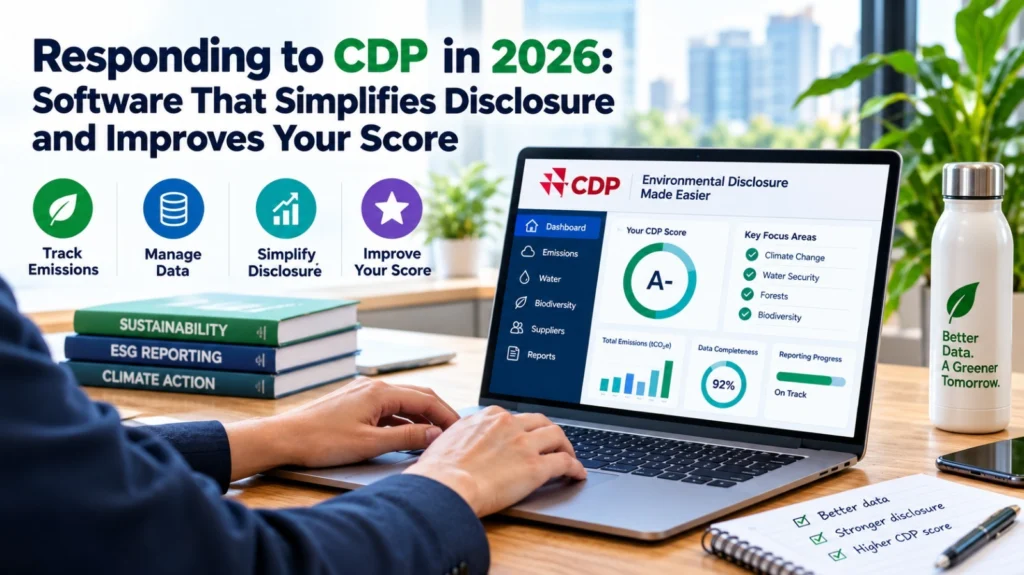
For sustainability teams, CDP disclosure can quickly become one of the most demanding reporting tasks of the year. Collecting emissions data is only part of the job. Companies also need to coordinate with different departments, understand environmental risks, document their policies and make sure their answers are accurate and consistent.
I often see the same challenge across sustainability reporting: the information a company needs already exists somewhere, but it is scattered across spreadsheets, internal reports, supplier questionnaires and different software systems. Bringing everything together at the right time is where things become complicated.
That is why choosing the right sustainability reporting software matters in 2026. The right platform can help teams organise environmental data, reduce repetitive work and prepare stronger CDP responses. But software alone will not guarantee a higher score. The real value comes from combining better systems with reliable data, clear accountability and a genuine understanding of what CDP expects.
Why CDP Disclosure Is Becoming More Demanding
CDP is an environmental disclosure system used by organisations to communicate information about climate change, water security, forests and other environmental topics. Investors, customers and business partners use this information to understand environmental risks and assess how companies manage them.
The 2026 disclosure cycle continues to place importance on environmental transparency, with updated questionnaires, reporting guidance and scoring requirements. The questionnaire an organisation receives depends on factors such as its size, sector and the environmental issues relevant to its operations. Nature-related topics, including biodiversity, plastics and oceans, also form part of the wider disclosure landscape. CDP’s 2026 disclosure guidance provides the latest official information.
For sustainability professionals, the challenge is not simply answering questions. It is demonstrating that the answers are supported by evidence and reflect how the business actually operates.
A company might have its greenhouse gas emissions figures ready but still struggle to explain how climate risks influence financial planning, who oversees environmental targets or how suppliers are being engaged.
This is where structured reporting processes and dedicated software can make a meaningful difference.
What Should CDP Reporting Software Actually Do?
Before investing in another sustainability platform, it is worth asking a simple question: which part of the disclosure process is creating the most work?
For some teams, it is collecting data from multiple facilities. For others, it is calculating emissions, managing supplier information or finding evidence to support questionnaire responses.
A useful platform should address these practical problems rather than simply offer an impressive dashboard.
Here are five capabilities worth looking for:
1. Centralised environmental data: Teams should be able to organise emissions, energy consumption, water usage and other relevant environmental information in one place.
2. Automated calculations: Software can help with emissions calculations and other repeatable reporting tasks, provided the underlying activity data and calculation methods are reliable.
3. Evidence management: Supporting documents, policies, calculations and approvals should be easy to locate when preparing or reviewing responses.
4. Reporting and framework alignment: Mapping data across CDP and other reporting frameworks can reduce duplication, although teams must still check that each disclosure requirement is satisfied.
5. Integration with the CDP Portal: Where supported, direct data transfer can reduce manual entry and help teams manage the disclosure process more efficiently.
CDP’s Disclosure API programme supports data transfer through participating software providers. Companies should confirm the provider’s current participation, available integrations and compatibility with their own questionnaire before selecting a platform.
Sustainability Software to Consider for CDP in 2026
There is no single platform that suits every organisation. A multinational business with complex supply chains will have different requirements from a smaller company with a lean sustainability team.
The following providers are worth evaluating based on the work your team needs to complete.
1. Workiva: Connecting Sustainability Reporting and Governance
Workiva is worth considering for organisations that need structured reporting workflows, document collaboration and oversight across multiple teams.
CDP disclosure often involves sustainability, finance, risk, legal and operational departments. A platform that supports collaboration and traceability can make it easier to review information and establish who is responsible for each response.
It may be particularly relevant to businesses that already manage other corporate reporting activities through structured workflows.
2. Watershed: Managing Climate Data and Emissions
Watershed is a potential option for companies looking to organise emissions data and strengthen their climate reporting processes.
When CDP responses rely on information from facilities, energy bills, business travel and suppliers, teams need a consistent approach to collecting and reviewing those figures.
A climate-focused platform can help create a clearer picture of emissions and progress against reduction targets. Companies should check which CDP integration and reporting features are available for their chosen plan.
3. Persefoni: Supporting Carbon Accounting
Persefoni is another platform to evaluate when carbon accounting is a major part of the reporting challenge.
Accurate emissions information can support climate-related disclosures, internal decision-making and progress tracking. However, companies still need appropriate activity data, suitable calculation methods and clear documentation.
Carbon accounting software is most useful when it becomes part of the organisation’s regular reporting process rather than something used only when a questionnaire deadline approaches.
4. Sweep: Bringing Sustainability Data Together
Sweep is worth exploring for businesses that want to organise sustainability information across operations and supply chains.
Supplier engagement is particularly important when companies need information beyond their direct operations. A centralised system can help teams identify missing data, follow up with suppliers and track improvements over time.
Before choosing any platform, confirm its current CDP integration capabilities and whether those features support your specific disclosure requirements.
5. Novisto: Organising ESG Reporting Workflows
Novisto may suit organisations looking for a more structured approach to environmental, social and governance reporting.
For teams handling several reporting frameworks, a central system can help organise metrics, assign responsibilities and maintain supporting evidence. This can reduce the risk of different departments reporting inconsistent figures.
The important consideration is whether the platform fits your organisation’s reporting structure, existing technology and budget.
These providers are examples to assess, not a universal ranking. CDP has published information about participating software providers through its official disclosure resources. Check current integration details directly with each provider before making a decision.
Can Software Actually Improve Your CDP Score?
This is probably the question most sustainability teams want answered.
The short answer is that software can support a stronger response, but it cannot guarantee a better CDP score.
CDP scoring assesses disclosure quality and maturity against the applicable scoring methodology. A well-organised system can help teams provide more complete answers, maintain consistent data and identify gaps before submission.
However, a company still needs to meet the relevant requirements and demonstrate meaningful environmental management.
For example, a dashboard might show that a company has established an emissions reduction target. It does not automatically prove that the target meets the applicable criteria, has the necessary approval or is supported by a credible implementation plan.
Teams should therefore use software to identify weaknesses, not simply to fill in questionnaire fields faster.
Review the latest CDP scoring guidance and the methodology applicable to your questionnaire. Requirements can change between disclosure cycles.
How to Choose the Right Platform for Your Business
Before signing a contract, I would focus on three practical questions.
First, what problem are you trying to solve? If emissions calculations are taking too long, carbon accounting may be the priority. If information is scattered across departments, a broader ESG reporting platform may be more useful.
Second, how much manual work can the platform realistically remove? Ask for a demonstration using your actual reporting workflow. Check data imports, approval processes, evidence storage and any available CDP integration.
Third, can your team maintain the system throughout the year? A platform is only valuable when employees can use it consistently. Consider implementation time, training, subscription costs and the internal resources needed to maintain data quality.
It is also sensible to assign clear ownership for each major disclosure area. Software can flag missing information, but people still need to investigate gaps, approve responses and explain what the data means.
What Sustainability Teams Should Do Next
The most effective CDP preparation usually starts well before the next reporting cycle.
Review the previous response, identify recurring data gaps and document the evidence needed for important disclosures. Establish clear responsibilities across departments and create a regular schedule for reviewing environmental metrics.
If you have already submitted your 2026 response, use the experience to improve your process for the next cycle. If you are still working through outstanding reporting tasks, consult CDP’s official portal for the applicable deadlines, amendment rules and current guidance.
Do not wait until the next questionnaire arrives to discover that important supplier information is missing or that different departments use different emissions figures.
The Bottom Line
Responding to CDP in 2026 is not just a reporting exercise. It is an opportunity to improve how your organisation collects environmental data, manages risk and communicates its sustainability progress.
The right software can make that process more organised and less dependent on spreadsheets. But the best results come when technology supports clear responsibilities, credible evidence and meaningful environmental action.
Before choosing a platform, be honest about where your current process breaks down. Solve that problem first, and select software that helps your team do the work more reliably throughout the year.
A stronger CDP response begins with better information and clearer processes, not simply another reporting tool.