
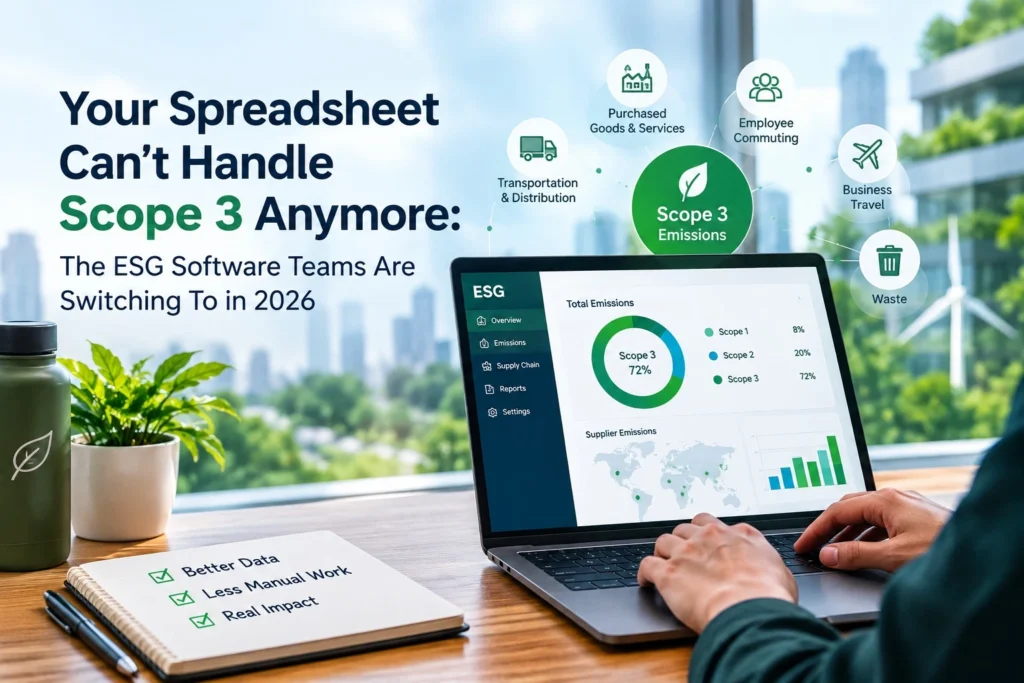
For many sustainability teams, Scope 3 emissions reporting starts with a spreadsheet. It is familiar, flexible and relatively easy to set up. You can collect supplier information, organise purchasing data, apply emissions factors and prepare an initial carbon footprint without introducing another software platform.
The difficulty begins when the business grows.
More suppliers need to be tracked. Finance teams send data in different formats. Emissions factors require updating, calculations need checking, and sustainability leaders are expected to explain where the numbers came from.
Suddenly, the spreadsheet that once made reporting manageable becomes another problem to solve.
In 2026, the conversation is shifting from whether spreadsheets are useful to whether they remain suitable for increasingly complex Scope 3 reporting. Dedicated ESG and carbon accounting platforms are attracting attention because teams need more than a workbook full of calculations. They need reliable data, traceable methodologies and a clearer way to manage emissions across their value chains.
Why Scope 3 Becomes Difficult to Manage in Excel
Scope 3 covers indirect greenhouse gas emissions across an organisation’s value chain, including purchased goods and services, transportation, business travel, waste and the use of sold products.
Unlike emissions from a company’s own facilities, much of this information sits outside its direct control.
Procurement may hold supplier spending data. Operations may manage transportation information. Finance may have the invoices. Suppliers may have their own emissions reports, while the sustainability team is responsible for bringing everything together.
Excel can support this work, particularly when the organisation has a relatively small inventory. But the process becomes harder to maintain as the number of suppliers, reporting categories and data sources increases.
A formula can calculate emissions correctly and still produce a misleading result if the underlying data is incomplete, incorrectly classified or based on an outdated emissions factor.
The question is not whether Excel is a bad tool. It is whether the reporting process has become too complicated to manage reliably through spreadsheets alone.
The Three Problems Sustainability Teams Keep Running Into
1. Collecting supplier data becomes a full-time job
One of the biggest challenges in Scope 3 accounting is obtaining useful information from suppliers.
Some suppliers can provide product-level emissions data. Others may share company-wide estimates, incomplete questionnaires or no emissions information at all.
Teams often end up chasing responses through emails, maintaining separate tracking sheets and manually transferring information into a central workbook.
As the supplier base expands, keeping everything consistent becomes increasingly difficult.
Dedicated carbon accounting platforms can help centralise supplier information, organise data requests and track responses. Some also support supplier engagement and data validation.
However, software cannot automatically make every supplier’s information accurate. Teams still need sensible data requirements, clear communication and a process for reviewing what comes back.
2. Nobody is completely sure which numbers to trust
Emissions calculations depend on the quality of the underlying information and the methodology used.
When supplier-specific data is unavailable, companies may use spend-based estimates, industry averages or other appropriate estimation methods. These approaches can be useful, but their limitations need to be understood.
The problem with a large spreadsheet is that assumptions can become difficult to track.
Who selected the emissions factor? When was it last updated? Was the same methodology applied to every reporting period? Did someone change a formula without documenting the reason?
A dedicated platform can help preserve calculation histories, document emissions factors and record changes to reported figures. These capabilities make it easier for sustainability teams to explain how their inventory was developed.
That matters when leadership, customers, external reviewers or other stakeholders ask for supporting evidence.
3. Annual reporting turns into a recurring data-cleaning exercise
Many teams spend more time preparing data than analysing what it means.
Purchasing records may contain inconsistent descriptions. Supplier names may appear differently across systems. Units of measurement may not match, and information from different departments may arrive in separate files.
The sustainability team then has to clean, categorise and reconcile everything before meaningful analysis can begin.
ESG software can reduce some of this repetitive work through integrations, data mapping, automated calculations and validation checks.
The actual benefit depends on the platform and how well it connects with the company’s existing systems. A poorly configured platform can still leave teams maintaining spreadsheets outside the software.
The goal should be to reduce manual work, not simply move it somewhere else.
What ESG Software Teams Are Switching To in 2026
There is no single platform that suits every organisation. The market includes specialist Scope 3 tools, full carbon accounting systems, enterprise sustainability platforms and broader ESG reporting solutions.
A few established options illustrate the different approaches available.
Normative focuses on carbon accounting, emissions calculations and value-chain emissions management. It may suit organisations looking for a structured approach to building and maintaining a greenhouse gas inventory.
Watershed offers carbon measurement and management capabilities, including work involving suppliers and value-chain emissions. It is worth evaluating for organisations seeking to connect emissions measurement with decarbonisation programmes.
Sweep provides carbon management and sustainability data capabilities for organisations working across emissions measurement, reporting and reduction planning.
SAP Sustainability solutions may be relevant for larger organisations that want to connect carbon accounting with existing enterprise systems, financial information and operational data.
These are examples to investigate, not a universal ranking. Product capabilities, integrations, pricing and availability can vary by plan and implementation.
Before choosing a platform, teams should assess the complexity of their Scope 3 inventory, the quality of their existing data and the level of reporting assurance they need.
How to Know When It Is Time to Move Beyond Spreadsheets
A growing workbook does not automatically mean your organisation needs new software.
For a smaller business with limited reporting requirements, a well-managed spreadsheet may remain practical. The decision changes when maintaining the workbook starts consuming time that should be spent improving emissions performance.
Ask yourself three questions:
- Can your team trace reported emissions back to the original data, calculation method and emissions factor?
- Can you collect, validate and update information across suppliers without repeatedly rebuilding the same files?
- Can you compare reporting periods confidently without worrying about undocumented formula changes or inconsistent assumptions?
If these questions are becoming difficult to answer, it may be time to evaluate dedicated software.
Also consider the people responsible for maintaining the system. A platform should make the process easier to manage, rather than creating a dependency on one employee who understands every integration and calculation.
What to Check Before Choosing an ESG Platform
The best software is not necessarily the one with the longest feature list.
Start with the requirements that matter most to your organisation.
Scope 3 coverage: Check whether the platform supports the relevant emissions categories, supplier-level information and calculation methods your business needs.
Data quality and traceability: Look for documented emissions factors, clear calculation methodologies, change histories and practical ways to review estimates.
Integrations: Find out whether the platform can connect to your finance, procurement, ERP and other relevant systems. Confirm which integrations are included and which require additional configuration.
Supplier engagement: If supplier data is a major challenge, examine how the platform collects information, tracks responses and improves data quality over time.
Reporting requirements: Make sure its outputs support your reporting frameworks, internal management needs and any applicable assurance requirements.
Implementation and cost: Ask about onboarding, data migration, training, ongoing maintenance and the staff time needed to operate the platform.
A demonstration using your own data, where feasible, will usually reveal more than a generic product presentation.
The Real Goal Is Better Emissions Data, Not Another Dashboard
Switching from spreadsheets to ESG software should not be treated as a sustainability achievement in itself.
The real value comes from improving how an organisation understands and manages its emissions.
More reliable supplier information can help identify where emissions are concentrated. Better visibility into purchasing categories can inform procurement decisions. Consistent calculations can make year-on-year comparisons more useful and help teams prioritise areas for improvement.
Software can support those decisions, but it cannot replace good governance, supplier cooperation or a credible emissions reduction strategy.
As Scope 3 reporting becomes more demanding, sustainability teams need to decide which manual processes remain useful and which have become unnecessary obstacles.
Excel may still have a place in the process. But when every reporting cycle involves chasing data, repairing formulas and questioning old assumptions, it is worth considering a more structured approach.
The important question for 2026 is simple: Is your team spending its time reducing emissions, or spending most of it trying to calculate them?
That answer may tell you more about the need for ESG software than any product demonstration.